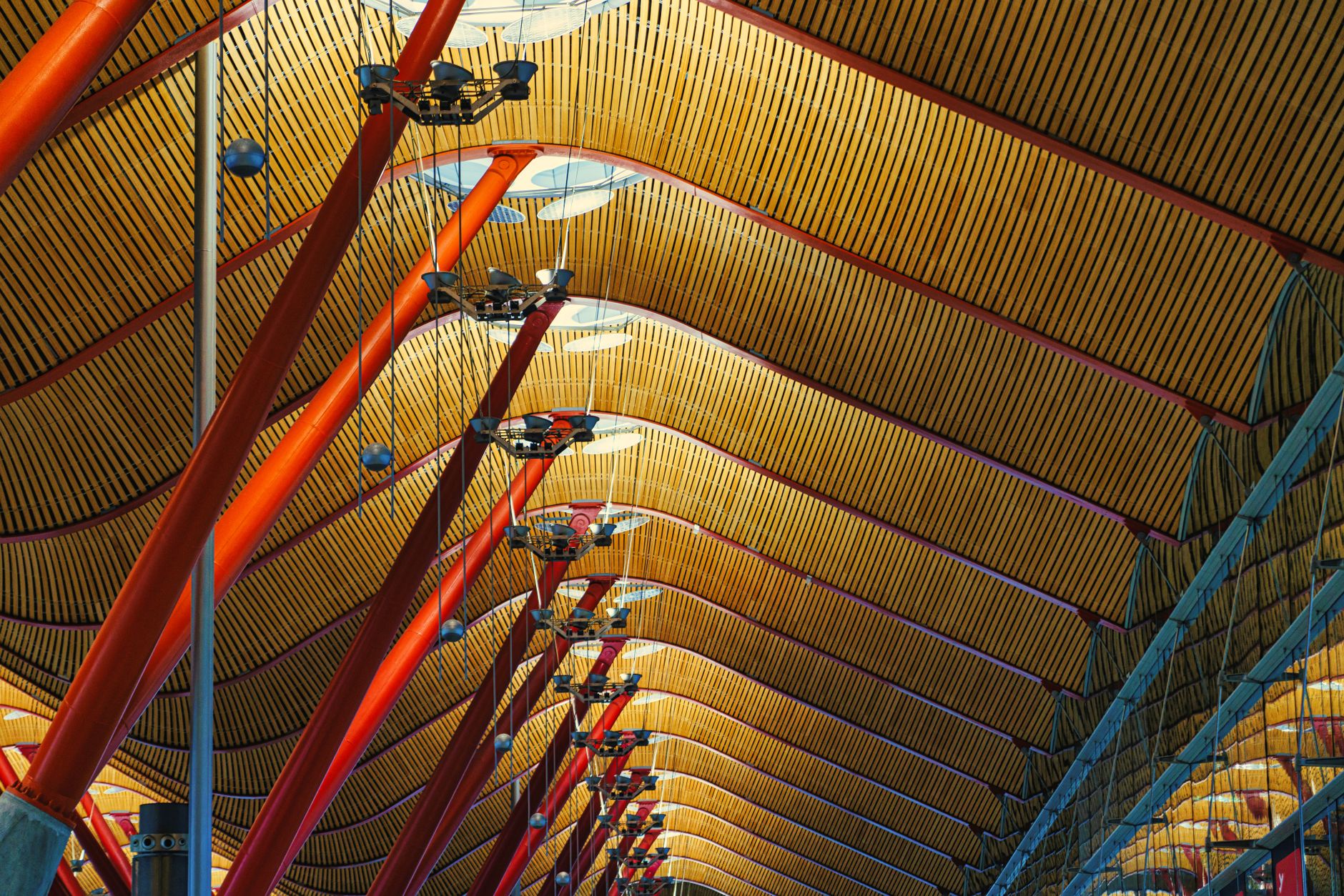
The first thing most people notice about Barajas is the ceiling of Terminal 4: a long, rippling wave of bamboo strips held up on yellow steel trees, fading through orange and red towards the far end of the building. The second thing they notice, usually a few minutes later, is how far they have to walk. Madrid airport is one of the largest in Europe, and it is split into two separate terminal complexes with a Metro stop between them, so the first thing to settle is which of the two you need. If you are after the transfer itself — Metro against taxi against bus, step by step — that has its own page: getting from Madrid airport to the city centre. For a bed near the runway before a dawn flight, see hotels near Madrid airport. This guide is about the airport itself.
It covers how the terminals fit together and which airlines use which, what happens between stepping off the plane and reaching the taxi rank, how long security and passport control really take, where to eat, sleep, shower and leave a bag, lounges, connections, and the handful of mistakes that make people miss flights here. Prices and times were checked in October 2026; treat them as the right order of magnitude rather than a promise, because fares in Madrid tend to move each January.
Madrid Airport at a Glance
The official name is Adolfo Suárez Madrid-Barajas, after the prime minister who steered Spain’s transition to democracy — the name was added in 2014, and nobody in Madrid uses it in conversation. Locals say “Barajas”, after the old village on the airport’s southern edge. The IATA code is MAD. It sits about 12 kilometres north-east of central Madrid, and how long the drive in takes depends on traffic, your terminal and where in the city you are going.
It is Spain’s busiest airport, handling well over 60 million passengers a year, and it is the hub of Iberia and a key link between Europe and Latin America. That last point shapes the place more than you might expect: a large share of long-haul traffic is heading to or from Bogotá, Lima, Buenos Aires, Mexico City and São Paulo, which means the non-Schengen passport queues swell in the early morning when the overnight flights land.
| What | Detail | Typical cost (Sept 2026) |
|---|---|---|
| Terminals | T1, T2, T3 (joined together) and T4 with its satellite T4S | — |
| Free inter-terminal bus | Links T1–T2–T4 around the clock | Free |
| Metro Line 8 | T1-T2-T3 and T4 to Nuevos Ministerios: about 12 minutes from T1-T2-T3, under 20 from T4 | About €4.50–€5 including the €3 airport supplement |
| Cercanías C1 | T4 only; direct to Chamartín, Nuevos Ministerios, Recoletos, Atocha and Príncipe Pío | About €2.60 |
| Exprés Aeropuerto bus (line 203) | 24 hours, to Cibeles and Atocha | €5 |
| Taxi | Flat fare to anywhere inside the M-30 ring road | €33, no luggage or passenger supplements |
| Wi-Fi | Free and unlimited throughout | Free |
| Sleeping capsules | GettSleep in T4S (airside); Aerotel in T4 (level −1) | Book by the hour; check current rates |
How the Terminals Fit Together
Get this bit right and the rest of the airport is easy. Barajas is not one building with five doors. It is two separate complexes on opposite sides of the runways.
- The south complex: T1, T2 and T3. These three are physically joined, one long building with three names. You can walk from T1 to T2 landside in a few minutes, and T3 is really an extension of T2 used for a handful of flights. The Metro station here is called Aeropuerto T1-T2-T3 and it sits under T2.
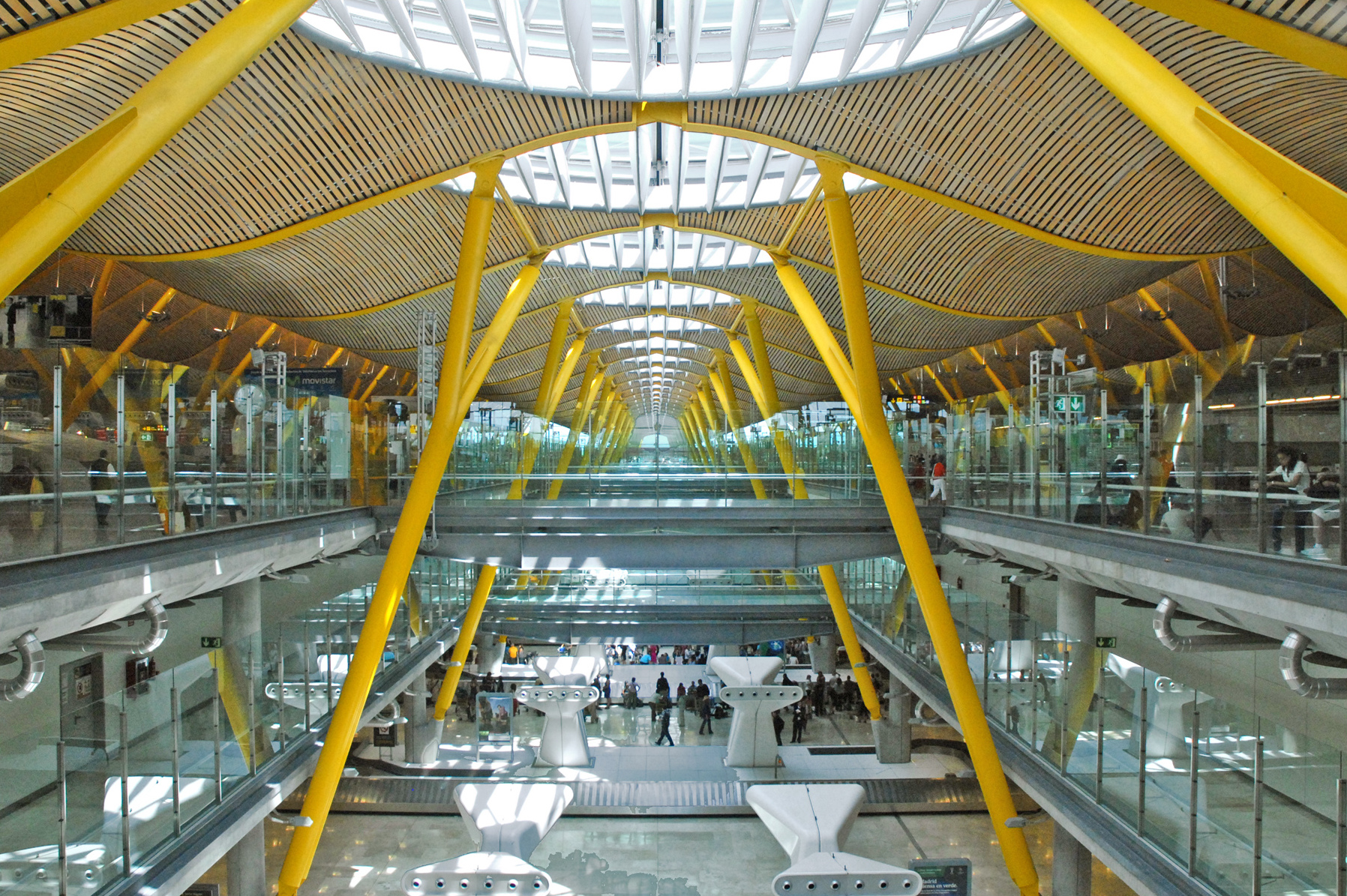
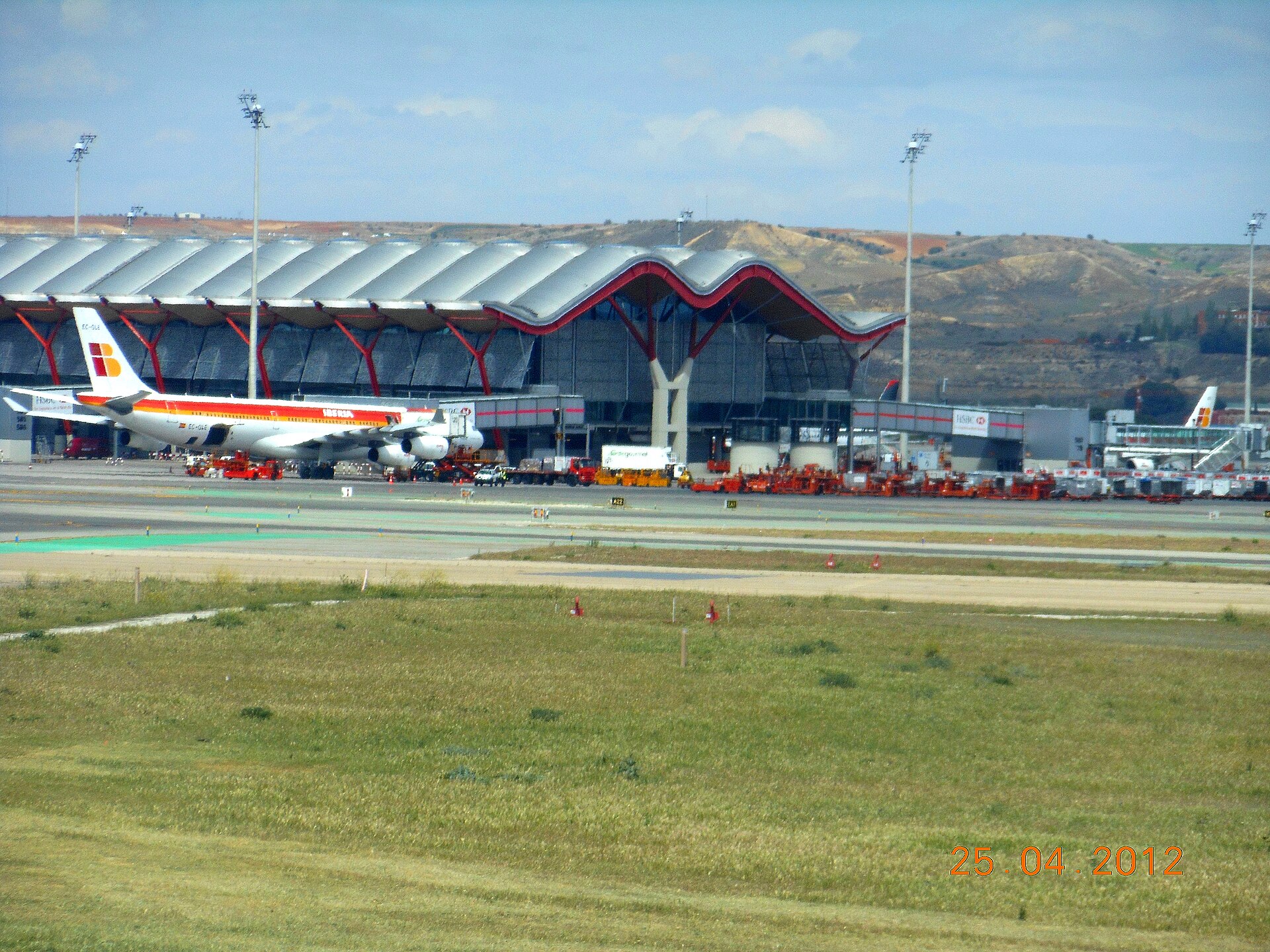
- The north complex: T4 and T4S. About three kilometres away by road. T4 is the main building, the one with the famous roof, and T4S is its satellite, standing on its own out on the apron. The two are linked by an underground automated train that takes about three minutes. T4S cannot be reached from the street; every passenger gets there through T4.
There is no airside connection between the two complexes. If you land in T4S and your onward flight leaves from T2, you are going to take a bus across the airfield, and depending on your passport and ticket you may have to go through security again at the other end. That is the single most important fact on this page, and it is the reason connection times at Madrid run longer than the printed minimum suggests.
Which terminal is my flight?
The broad pattern is stable, but Madrid does shuffle airlines around, so treat what follows as a starting point and confirm on your booking or the airline’s app 24 hours before you fly.
| Terminal | Who mostly uses it | What it feels like |
|---|---|---|
| T4 / T4S | Iberia, Iberia Express, Air Nostrum (Iberia Regional), and oneworld partners such as British Airways, American Airlines, Qatar Airways, Finnair and LATAM, plus a number of other long-haul carriers | Big, bright, modern and long. Schengen flights mostly from T4, non-Schengen and long-haul mostly from T4S |
| T1 | Non-Schengen flights from many non-oneworld carriers — much of the UK, North America and long-haul traffic that is not Iberia — and several low-cost airlines | Older, lower ceilings, busier than it looks from the outside |
| T2 | Air Europa and SkyTeam partners, Star Alliance carriers on Schengen routes, and a large share of Spanish domestic flying outside Iberia | Functional, compact, easy to navigate |
| T3 | A small number of flights, sharing facilities with T2 | You will rarely start or end a journey here; when you do, you walk through T2 |
A practical note on the Schengen split. Flights to and from the 29 countries of the Schengen area are treated like domestic flights: normally no passport control on the way out or in, although temporary border checks can be brought back. Everything else — the UK, Ireland, the Americas, Morocco, most of the Middle East and Asia — goes through a passport booth. In the south complex, T1 handles most of that non-Schengen traffic; in the north, T4S does.
Moving between terminals
The free inter-terminal bus runs 24 hours a day between T1, T2 and T4. It is signposted in each building (look for “Autobús entre terminales” or the bus pictogram) and picks up from the arrivals level. During the day buses come every few minutes; late at night the gap stretches. Budget generously for the whole hop, walk to the stop and wait included, and more so after dark.
You can also do the hop by Metro Line 8 — Aeropuerto T1-T2-T3 to Aeropuerto T4 is two stops, with Barajas in between — but it costs you a fare, and the bus is free. Take the bus.
If you are already airside in T4 and need T4S, you use the underground people-mover, which is signposted to the satellite gates. Allow ten minutes from the security exit to arriving under T4S, and more if there is a passport check on the way, which there will be for non-Schengen departures.
Arriving at Madrid Airport: What Happens, in Order
The arrivals process at Barajas is logical once you have seen it once. The first time, it can feel like a very long walk with no obvious end.
1. Off the plane and walking
At T4 and T4S, especially, the walk from the gate to passport control can take ten to fifteen minutes on its own. There are moving walkways, but they do not cover everything. If you are arriving at T4S, you will follow signs for baggage reclaim and exit (Recogida de equipajes y salida), and those signs lead you to the people-mover that carries you under the apron to the main T4 building. Nobody collects bags at T4S; the reclaim hall is in T4.
2. Passport control (non-Schengen arrivals only)
If you are flying in from outside Schengen, you meet the border police before reclaim. EU, EEA and Swiss citizens have their own lanes and, in most cases, automated e-gates. Everyone else joins the other queue.
The EU’s Entry/Exit System (EES) has changed this experience. Non-EU visitors now have fingerprints and a facial image captured on their first entry, rather than a stamp in the passport, and that first registration adds time. Later entries are quicker because the record already exists. On a quiet mid-afternoon the whole passport stage might take fifteen minutes. UK travellers should note that they queue with the non-EU passports now, however strange it still feels.
Entry rules have been changing, and ETIAS — the online travel authorisation for visa-exempt visitors — has had its timeline revised. Check the official EU travel pages for the current requirements before you book rather than relying on what a friend was told last year.
3. Baggage reclaim
The carousel number shows on screens as you enter the hall. In T4 the reclaim hall is enormous, and it can take a while for bags to appear after an early-morning long-haul arrival. There are free trolleys. If your bag does not show up, the airline’s handling agent desk is inside the reclaim hall — file the report there, before you leave, and keep the reference number. Once you walk through the exit doors you cannot come back in.
4. Customs
Green channel if you have nothing to declare, red if you do. For most visitors this is a walk past two tables. Arrivals from outside the EU carrying €10,000 or more in cash must declare it.
5. The arrivals hall and the way into town
Through the doors you are in the public arrivals hall. At T4 you will find cash machines, a pharmacy, cafés, car hire desks and the tourist information point. The taxi rank is directly outside; the Exprés Aeropuerto bus stop is signposted along the kerb; the Metro and Cercanías stations are below you, reached by lifts and escalators.
Which of those you pick depends on where you are staying, how much luggage you have, how many of you there are and what time it is. It is the most common question anyone asks about this airport, and it is answered properly, with times and fares for each option, in our guide to getting from the airport to central Madrid. The short version: two or more people with bags heading anywhere central should take the €33 flat-fare taxi; solo travellers on a budget heading for Sol, Gran Vía or Salamanca do fine on Line 8; anyone landing at T4 and staying near Atocha or Chamartín should look at the C1 train first; and at 03:00 you have the 24-hour Exprés Aeropuerto bus or the N32 night bus, which links every terminal with Avenida de América at the ordinary EMT fare.
Departing from Madrid Airport
How early to arrive
The usual advice — two hours for short-haul, three for long-haul — is sound here, with a few Madrid-specific adjustments.
- Schengen flight, hand luggage only, online check-in done: 90 minutes before departure is comfortable on most days. Security at T4 is usually well staffed and fast.
- Non-Schengen flight from T4S: allow at least two and a half hours. You clear security in T4, then take the train to T4S, then clear outbound passport control. Those are three separate places, and the walk between them is long.
- Non-Schengen from T1: two and a half hours on summer mornings. T1 is the older building, and its queues build quickly.
- Checking a bag with a low-cost carrier: the bag-drop queue is often the slowest part of the whole process. Add half an hour.
- Friday afternoons, the start of August, Easter week and the days around 6 January: add another 30 minutes to all of the above. Spanish holiday departures pile into the domestic and Schengen queues at the same time.
And the one that catches people: check which terminal before you set off. Taking Line 8 to Aeropuerto T1-T2-T3 when your flight leaves from T4 costs you a transfer on the inter-terminal bus at the worst possible moment, and how long you wait for it depends on the time of day.
Check-in and bag drop
Every terminal has a departures level with check-in rows marked by number, and screens that tell you which counters your flight is using. Iberia and British Airways in T4 have self-service kiosks and bag-drop machines that make the counter unnecessary for most people. Check your own airline’s bag-drop deadline: Ryanair, for one, closes bag drop 40 minutes before departure, moving to 60 minutes from 10 November 2026. Miss the cut-off and you cannot count on your bag making the flight.
Security
Madrid’s security lanes follow the standard EU rules on liquids: containers of 100 ml or less in a single clear, resealable bag of about one litre, laptops and large electronics out of the bag unless the lane has the newer scanners and staff tell you otherwise. Rules have been relaxed and re-tightened across Europe more than once recently, so follow what the officers at the lane say, not what you remember from your last trip. Fast Track is available at the main terminals for eligible passengers and can be bought as a standalone extra through the airport’s website; on a bad morning it can save you half an hour.
Outbound passport control
For non-Schengen departures there is a second checkpoint after security. At T4 it comes after the underground train, as you enter the satellite building; in T1 it sits before the non-Schengen gates. Leave time for it, and make sure any tax-free shopping paperwork is done before you pass through (see below), because the DIVA validation kiosks are on the landside.
Gates and boarding
Watch the departure screens and your airline’s app for your gate number. Nobody enjoys waiting by a screen, but in T4 and T4S the walks between gate areas can be long enough — the signs themselves say twenty-plus minutes to some piers — that it pays to stay near the centre of the building until your gate appears, then move straight away. Your boarding pass shows when boarding closes; be at the gate before then.
Eating and Drinking at Barajas
Let’s be honest about the food: it is airport food, priced like airport food, and nobody should plan a last meal in Spain around it. That said, it is better than it was, and you can eat something recognisably Spanish before you leave.
- Proper sit-down meals cluster airside in T4 and T4S and airside in T1, with Spanish chains doing tortilla, jamón, croquetas and a sandwich (bocadillo) or two. Expect to pay roughly double what the same plate costs in a neighbourhood bar in Madrid.
- Quick coffee and pastry is everywhere, landside and airside. A café con leche and a croissant will cost you meaningfully more than in town, but not outrageously so.
- Late-night food matters if you are arriving at 01:00 or leaving at 06:00. Choice shrinks sharply in the small hours, so check each outlet’s opening times on the airport’s site before you rely on one.
- Water: bring an empty bottle through security. There are drinking fountains airside, and a small bottle of water bought at a gate café is one of the least defensible prices in the building.
If you have a few hours and the choice is between an airport sandwich and a proper plate of food, and your flight is not from T4S, remember that central Madrid is a short Metro ride away. That is a decision for a long layover, not a two-hour connection, and we will deal with it properly in the layover section below.
Shopping and Tax-Free Refunds
The departure areas have duty-free and other shops. You will find the usual walk-through duty-free store, Spanish fashion brands, a few luxury names, and plenty of places selling jamón vacuum-packed for travel, olive oil, saffron and turrón. Prices on food souvenirs are noticeably higher than in the city; if you want a proper jamón, buy it in town, where the choice is wider and a shop will talk you through grades — see our guide to where to buy jamón ibérico in Madrid.
If you are a non-EU resident and have bought goods in Madrid with a tax-free form, you need to validate it before you leave the EU. Spain uses an electronic system called DIVA: you scan the form (or the barcode on your digital receipt) at a DIVA kiosk, and the kiosk tells you whether it is approved or whether customs want to see the goods. Do this before security, with the goods still in your checked bag in case they are asked for. If your journey leaves the EU from another airport — say you connect through Paris to New York — the validation happens at the last EU airport, not at Madrid. The details, including minimum spends and refund operators, are in our guide to tax-free shopping in Madrid.
Lounges
Iberia’s lounges are the best-known at Barajas. The Velázquez lounge in T4 serves Schengen departures and the Dalí lounge in T4S serves non-Schengen and long-haul flights. Both are open to Iberia and oneworld business-class passengers and to oneworld Sapphire and Emerald members under the alliance rules. Expect decent Spanish wine, a hot food station and showers in the long-haul lounge.
Aena, which runs the airport, also operates its own VIP lounges in several terminals. These are open to anyone who pays for access, and they accept the main lounge-membership programmes such as Priority Pass. Walk-up pricing is usually worse than booking online a few days ahead; check the current rate on the Aena website before you commit, because it varies by lounge and time.
Is a paid lounge worth it? For a two-hour Schengen connection, rarely — by the time you have found it, you have forty minutes left. For a long morning in T4S before a transatlantic flight, with a shower and a quiet seat and unlimited coffee, it can be excellent value compared with buying the same things piecemeal at gate cafés.
Sleeping at the Airport
Barajas stays open overnight, and you can wait in the terminals, but access is limited to passengers, the people with them and airport staff, so keep your ticket or boarding pass to hand. Plenty of people do. It is not comfortable: the terminal lights stay on, cleaning machines come through, announcements continue, and most seating has armrests precisely so you cannot lie across it. The quietest corners tend to be the upper levels of T4 and the far ends of the T1 hall.
There are two better options inside the airport:
- GettSleep sleeping pods in T4S, airside. Bookable for anything from one to 24 hours, with shared hot showers and a 24-hour reception. The obvious use is a long connection between two non-Schengen flights where you never need to leave the satellite.
- Aerotel Madrid in T4, level −1. A proper transit hotel with private rooms bookable by the hour; check which lengths of stay are available when you book. Because it is on the public side, it works for arrivals and departures as well as connections, but it does mean clearing security again afterwards.
If you need a real night’s sleep — an early departure, a late arrival with an onward train the next morning — a hotel just outside the perimeter, with a free shuttle, usually costs less than these and gives you a proper bed. Our guide to hotels near Madrid airport covers which ones actually run their shuttle at the hours you need.
Connections: Changing Planes at Madrid
This is where Barajas has a reputation, and it is half deserved. The airport itself runs well. The problem is that a published minimum connection time assumes everything goes to plan, and in Madrid there are a lot of places where it can stop going to plan.
Connections within T4 and T4S (the Iberia hub)
Most Iberia and oneworld connections stay within the T4 complex. If both flights are Schengen, you stay airside in T4 and simply walk. If one flight is Schengen and the other is not, you will pass through a passport check and use the underground train to or from T4S. Iberia sells these connections with a minimum of about an hour for many combinations; if your inbound flight is running late and lands at T4S at the same time as three other long-hauls, that hour gets very thin. Ninety minutes is a much calmer figure.
If you are on a single ticket and miss the connection, the airline rebooks you. If you have built the connection yourself on two separate tickets, it is your problem — and at Madrid, we would not do a self-transfer with checked bags in under three hours.
Connections between T1/T2 and T4
This is the connection that goes wrong. Arriving on, say, an Air Europa flight into T2 and leaving on Iberia from T4S means leaving the airside area, taking the free bus across the airport, and going back through security — and possibly passport control — at the other end. Allow at least two hours on a single ticket and three on separate tickets.
Checked bags on a connection
On a single ticket, your bag is normally checked through to your final destination and you do not see it in Madrid. There is one exception worth knowing: if Madrid is your first point of entry into Schengen and your onward flight is within Spain or Schengen, some itineraries require you to collect your bag and clear customs before re-checking it. Ask at check-in at your origin, and read the bag tag. It should show your final airport code.
Long layovers
With five or more hours and a flight from any terminal but a passport check waiting for you on return, going into the city is realistic. Line 8 takes you to Nuevos Ministerios in about 12 minutes from T1-T2-T3 and under 20 from T4, and the C1 from T4 runs direct to Chamartín, Nuevos Ministerios, Recoletos, Atocha and Príncipe Pío. From Atocha the Prado is a ten-minute walk. The rule of thumb we give everyone: under four hours, stay in the terminal. The inter-terminal transfers and security on the way back eat whatever margin you thought you had. Our Madrid layover guide has itineraries by hours available.
Practical Services Inside the Terminals
Wi-Fi, charging and working
Wi-Fi is free and unlimited throughout the airport. You connect to the airport network and accept the terms on a splash page; there is no time limit, and it is fast enough for video calls in most areas. Some seating areas have charging points, but you cannot count on finding a free one. If you rely on your phone for your boarding pass, carry a power bank.
EU and UK visitors on a roam-like-home tariff generally need nothing at all for data. Travellers from further afield will usually do better with a Spain eSIM bought before they fly — around €12 for 10 GB — than at the airport SIM kiosks, which are priced for people who have just landed and have no choice.
Money
Cash machines are in every arrivals and departures hall. Use a machine belonging to a Spanish bank rather than a standalone currency-exchange brand, and always decline the offer to be charged “in your home currency” — dynamic currency conversion is how an airport cash withdrawal becomes an expensive one. The exchange bureaux in the terminals give poor rates. You need very little cash in Madrid in any case: contactless cards work on the Metro, the airport bus, taxis and almost every bar.
Left luggage
Aena lists left-luggage services in the terminals, including T1 and T4, run by a private operator on the public side of the building. Prices are per item per day and depend on size; check the current rate before relying on it. For a layover this is the key to going into town without your case. If you are dropping a bag for longer — for a day trip after you have checked out of a city hotel — a left-luggage service near your hotel or the train stations is usually cheaper and more convenient than coming back out to the airport.
Pharmacies, medical help and prayer rooms
There are pharmacies on both sides of security in the larger terminals, including T4 landside. Medical assistance is available around the clock; any member of airport staff will call it for you. There are multi-faith prayer rooms and baby-care rooms, all marked on the terminal plans on the Aena website and app.
Assistance for passengers with reduced mobility
Aena provides a free assistance service (called PMR, for personas con movilidad reducida) from the kerb or the car park to your seat on the plane and on arrival. It is available to anyone who needs it, not only wheelchair users — including people who find the long walks difficult, which at T4 is a lot of people. Request it through your airline at least 48 hours before you fly. There are signed help points at the terminal entrances where you can call for assistance on the day. For getting around the city afterwards, see our guide to wheelchair-accessible transport in Madrid.
Smoking
Smoking is banned inside the terminals. There are no airside smoking rooms at Barajas, which means smokers on a connection either wait or clear security twice.
Getting to and from the Airport: The Options Compared
The full walkthrough, with step-by-step instructions for each option, lives on our airport to city centre page. Here is the comparison you need to make the choice.
| Option | Terminals | To | Time | Cost | Best for |
|---|---|---|---|---|---|
| Metro Line 8 | T1-T2-T3, T4 | Nuevos Ministerios, then change | About 12 min to Nuevos Ministerios from T1-T2-T3, under 20 from T4; allow extra for the onward change | About €4.50–€5 total | Solo travellers, light luggage, staying near a Metro line |
| Cercanías C1 | T4 only | Chamartín, Nuevos Ministerios, Recoletos, Atocha, Príncipe Pío | Check Renfe’s timetable | About €2.60 | Anyone arriving at T4 heading to Atocha, or catching a train onward |
| Exprés Aeropuerto bus 203 | T1, T2, T4 | O’Donnell, Cibeles, Atocha (night buses end at Cibeles) | From Atocha: about 30 min to T1, 35 to T2, 40 to T4, traffic permitting | €5, contactless on board | Night arrivals, people staying near Retiro, Huertas or the Paseo del Prado |
| Taxi | All | Anywhere inside the M-30 | 20–45 min depending on traffic | €33 flat | Two or more people, heavy luggage, late nights |
| Uber, Cabify, Bolt | All, from marked pick-up zones | Door to door | 20–45 min | Varies with demand; sometimes cheaper than €33, often not | Addresses outside the M-30, where the taxi flat fare does not apply |
A few things worth knowing that do not fit a table. The €3 Metro airport supplement is charged on the way out of the airport stations and on the way in, and it is not covered by ordinary ten-trip tickets; the transport card pricing guide explains which passes do include it. The C1 station is only at T4, which makes it useless if you land in T1 unless you add the inter-terminal bus. If you are catching a high-speed train onwards from Atocha or Chamartín, many long-distance Renfe tickets include a free Cercanías connection — look for the code on your ticket before you pay for the C1. And the flat taxi fare is fixed in law: if a driver quotes you more for a destination inside the M-30, you are within your rights to say so. More on that in our Madrid taxi fares guide.
Driving and parking
Aena runs short-stay car parks beside each terminal and long-stay parks further out, connected by free shuttle bus. Booking online in advance can get you a discount. The car hire desks are in the arrivals halls, with cars collected from the terminal car parks.
If you are picking up a hire car, read this before you drive into the city. The whole of Madrid, all 21 districts, is a low-emission zone (ZBE), and whether you can drive in depends on your vehicle’s DGT environmental label. Spanish hire cars will normally carry the green “C” environmental label on the windscreen, which lets you drive in — check that it is there before you leave the car park. Foreign-registered cars cannot get the label at all. In practice, most visitors staying in the centre do not need a car, and the airport is the perfect place to pick one up at the end of your city stay, on your way out to the Sierra de Guadarrama or somewhere further.
The Mistakes That Cause Missed Flights at Barajas
Almost every airport horror story we hear about Madrid falls into one of these, and every one of them is avoidable.
- Going to the wrong terminal complex. T1-T2-T3 and T4 are not a short walk apart. Check your terminal the day before and again on the morning.
- Underestimating T4S. A flight “from T4” that actually departs from a T4S gate involves security, a train and a passport check. Leave time for all three before you think about a coffee.
- Treating the Metro as a clock. Line 8 runs from Nuevos Ministerios to the airport, so unless you start on it you will have a change, and how long that takes depends on where you set off. From Sol, 50 minutes to the terminal door is a sensible margin to plan around.
- Taking a taxi at rush hour without a margin. The A-2 and M-40 motorways towards Barajas can be much slower in the morning and evening commuter peaks. The Metro does not.
- Leaving tax-free validation until after security. The DIVA kiosks are landside. Once you are through, you cannot go back.
- Self-transfers with tight margins. Two separate tickets, one terminal complex each, less than three hours: do not do it.
Is Madrid Airport Good? An Honest Verdict
As a building, T4 is one of the most beautiful airport terminals in the world, and it is worth arriving in daylight at least once to see the light come through the roof. As a hub, it is efficient, genuinely 24-hour, well connected to the city, and considerably calmer than London Heathrow or Paris Charles de Gaulle. The rail link is excellent, the flat taxi fare is one of the fairest airport deals in Europe, and free unlimited Wi-Fi should be standard everywhere but still isn’t.
Its weaknesses are scale and separation. The walks are long. The two terminal complexes do not connect airside, which turns an ordinary missed connection into a small ordeal. T1 feels its age. And the non-Schengen arrivals queue at peak times, now with the EES registration added, tests everybody’s patience. None of that is a reason to avoid it. It is a reason to arrive knowing which building you need.
Frequently Asked Questions
How many terminals does Madrid airport have?
Five names, two complexes. T1, T2 and T3 are joined together on the south side; T4 and its satellite T4S are on the north side, about three kilometres away by road. A free bus links the two complexes around the clock.
Which terminal is Iberia at Madrid airport?
Iberia, Iberia Express and most oneworld partners operate from T4, with long-haul and non-Schengen flights usually departing from the satellite, T4S. Always confirm the terminal on your booking, because some partner flights and codeshares operate from other terminals.
Can I walk between terminals at Madrid airport?
Between T1, T2 and T3, yes — they are one building. Between those terminals and T4, no: take the free inter-terminal bus. Between T4 and T4S you take the automated underground train, which is part of the normal passenger route.
How long does it take to get from T1 to T4?
It varies with the wait: buses run round the clock but less often at night, so leave a generous margin for the walk to the stop and the ride. If you then need to clear security at T4, add that time too.
Is Madrid airport open 24 hours?
Yes. The terminals stay open all night, and you can wait landside with your ticket or boarding pass. Food outlets keep their own hours, so check the one you are counting on. Through the night you have the 24-hour Exprés Aeropuerto bus and the N32 night bus from Avenida de América; the Metro and C1 train do not run.
Can you sleep at Madrid airport?
You can, but a bench is not a bed. The better options are the GettSleep pods airside in T4S, the Aerotel transit hotel in T4 on level −1, or a nearby hotel with an airport shuttle.
How early should I get to Madrid airport?
Ninety minutes is fine for a Schengen flight with hand luggage and online check-in. For non-Schengen flights, especially from T4S or T1 in the morning, allow two and a half to three hours.
What is the cheapest way from Madrid airport to the city?
The Cercanías C1 from T4, at about €2.60, is cheapest if you can use it. From the other terminals, the €5 Exprés Aeropuerto bus and Metro Line 8 at around €4.50–€5 cost about the same; for two or more people with luggage, the €33 flat-fare taxi is often the best value per person.
Is there free Wi-Fi at Madrid airport?
Yes, free and unlimited in all terminals.
Is it worth leaving the airport on a layover in Madrid?
With five or more hours between flights, yes: the centre is a short train or Metro ride away. With fewer than four, stay put — getting back through security, and possibly across the airport, takes longer than people think.
If you are flying Iberia or another oneworld airline, almost everything will happen in one building. Our detailed guide to Madrid airport Terminal 4 and T4S walks through its gates, the train to the satellite, where passport control actually is, and how long connections really take.
Stuck between flights? Whether it is worth leaving the airport depends less on the length of your layover than on your terminals, your passport and whether your flights are Schengen. Our Madrid airport layover guide does the maths for 4, 6, 8 and 12 hours, with two short itineraries that start from the train under T4.
Related Madrid Guides
- Madrid Airport to City Centre: Metro, Train, Bus and Taxi
- Hotels Near Madrid Airport
- Madrid Metro Map and Guide
- Madrid Cercanías Trains
- Madrid Taxis and Fares
- Madrid Transport Card Pricing
- Madrid’s AVE Train Stations
- Tax-Free Shopping in Madrid
- Madrid Transportation Guide
Photo Credits
Terminal 4 hall with its yellow columns: Barajas Airport (Madrid) (4684560779) via Flickr (flickr.com/people/72746018@N00), CC BY 2.0, via Wikimedia Commons.
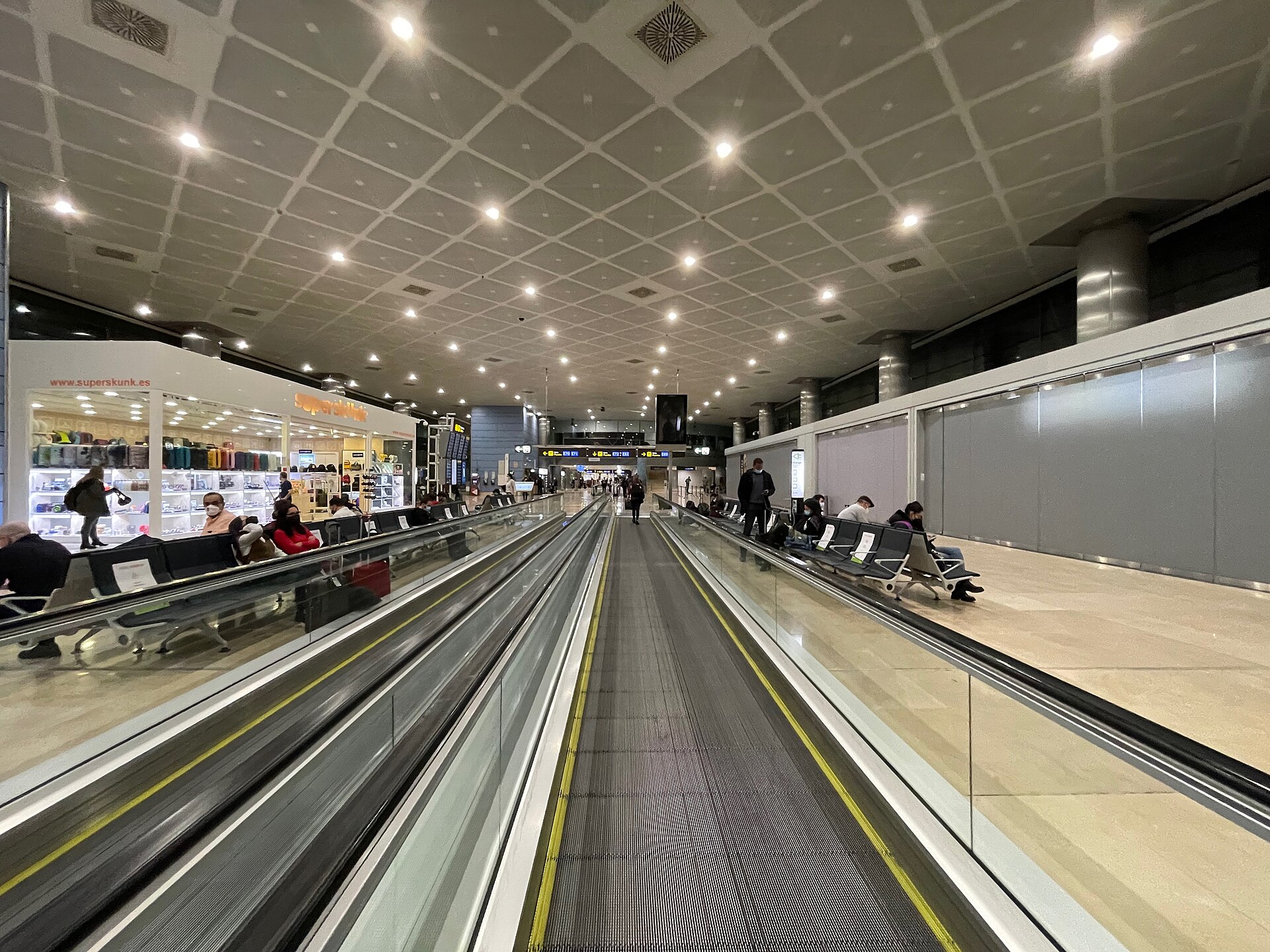
Moving walkway at Terminal 3: 202201 Terminal 3 Gate E of Madrid-Barajas Airport by MNXANL, CC BY-SA 4.0, via Wikimedia Commons.
Terminal 4S from the airfield: Madrid Barajas Airport-Terminal 4S (7146509957) by Charles from Port Chester, New York, CC BY 2.0, via Wikimedia Commons.