
A layover at Barajas raises the same question every time: is there enough time to see Madrid? The honest answer is sometimes, and less often than you hope. The city centre really is close — the train from Terminal 4 reaches Chamartín in 19 minutes — but getting off a long-haul flight, through passport control, into town, back out and through security again eats hours before you have looked at a single painting. This guide to a Madrid airport layover is a decision tree: what you can realistically do with 4, 6, 8 or 12 hours, what to do if you stay airside, and two micro-itineraries that work — the Prado and the Temple of Debod. For the airport itself, see our complete Madrid airport guide and the detailed Terminal 4 guide.
Times and prices were checked in September 2026. Transport fares change most Januaries and entry rules for non-EU travellers have been changing, so treat prices as the right order of magnitude and check the entry requirements for your passport before you plan to leave the airport.
The Short Answer
| Time between flights | Our verdict | What to do |
|---|---|---|
| Under 4 hours | Stay in the airport | Eat, shower, rest in a lounge or sleeping pod |
| 4–5 hours | Stay unless both flights are Schengen, you have no bags and you feel lucky | A lounge or a proper meal airside |
| 6 hours | Possible, with discipline | One thing: the Prado for an hour, or a walk around the centre |
| 8 hours | Yes | The Prado or the Royal Palace plus lunch, or a walk from Sol to the Temple of Debod |
| 10–12 hours | Absolutely | A proper half-day: a museum, the Retiro or Plaza Mayor, and a long Spanish lunch or tapas |
| Overnight | Yes, but decide between sleep and the city | Dinner and tapas in town, then an airport hotel or a pod |
Our rule of thumb: under four hours, stay in the terminal. Inter-terminal transfers, passport queues and the return security check eat the margin faster than anyone expects.
Before You Leave the Airport: Four Checks
1. Can you legally leave?
Leaving the airport means entering Spain and the Schengen area. EU, EEA and Swiss citizens can do so freely. Many other nationalities, including travellers from the UK, the US, Canada and Australia, can enter visa-free for short stays, but they now go through the EU’s Entry/Exit System, which registers fingerprints and a facial image on the first entry and adds time at the border. The ETIAS travel authorisation for visa-exempt visitors has had its start date moved several times; check the official EU site before you travel. If your passport normally needs a Schengen visa, you cannot leave the airport without one, regardless of how long your layover is.
2. Which terminals?
Your arrival and departure terminals matter as much as the time. T4 and T4S (Iberia and oneworld) are a separate complex from T1, T2 and T3, about three kilometres apart by road. If you land in one and leave from the other, add 20 to 30 minutes for the free inter-terminal bus. T4 also has the Cercanías train, which is the fastest way into the centre.
3. Where are your bags?
On a single ticket, checked bags normally travel straight to your final destination. On separate tickets, you will need to collect them, and then either take them with you or leave them somewhere. Aena lists left-luggage services on the landside in T1 and T4; check prices and hours before you land.
4. Schengen or not?
If both your flights are within Schengen, there is no passport control on the way out or back in. If either is not, you queue at the border — and on the way back, you clear security and outbound passport control. For non-Schengen departures from T4S, that means security in T4, the underground train, and then passport control in the satellite.
The Layover Maths
This is the calculation that decides everything. Take your total layover and subtract:
- Getting out of the airport: about 30 minutes from a Schengen flight with no bags; 45 to 75 minutes from a non-Schengen long-haul flight, especially in the early-morning rush.
- Getting into the centre: 35 to 50 minutes door to door.
- Getting back to the airport: the same again, plus a margin for a missed train.
- Being back at the terminal before departure: 1 hour 30 minutes for a Schengen flight with hand luggage; 2 hours 30 minutes for a non-Schengen flight from T4S or T1; more at peak times.
| Layover | Out of the airport | Travel both ways | Back before departure | Time in the city |
|---|---|---|---|---|
| 6 hours, non-Schengen both ways | 1 hour | 1 hour 30 minutes | 2 hours 30 minutes | About 1 hour |
| 6 hours, Schengen both ways, no bags | 30 minutes | 1 hour 30 minutes | 1 hour 30 minutes | About 2 hours 30 minutes |
| 8 hours, non-Schengen | 1 hour | 1 hour 30 minutes | 2 hours 30 minutes | About 3 hours |
| 12 hours, non-Schengen | 1 hour | 1 hour 30 minutes | 2 hours 30 minutes | About 7 hours |
An hour in the city is enough for one thing, done without hurry. Three hours is a proper taste. Seven hours is a real visit.
Getting into Madrid from the Airport
On a layover, speed and reliability matter more than saving a couple of euros.
From Terminal 4: the Cercanías C1
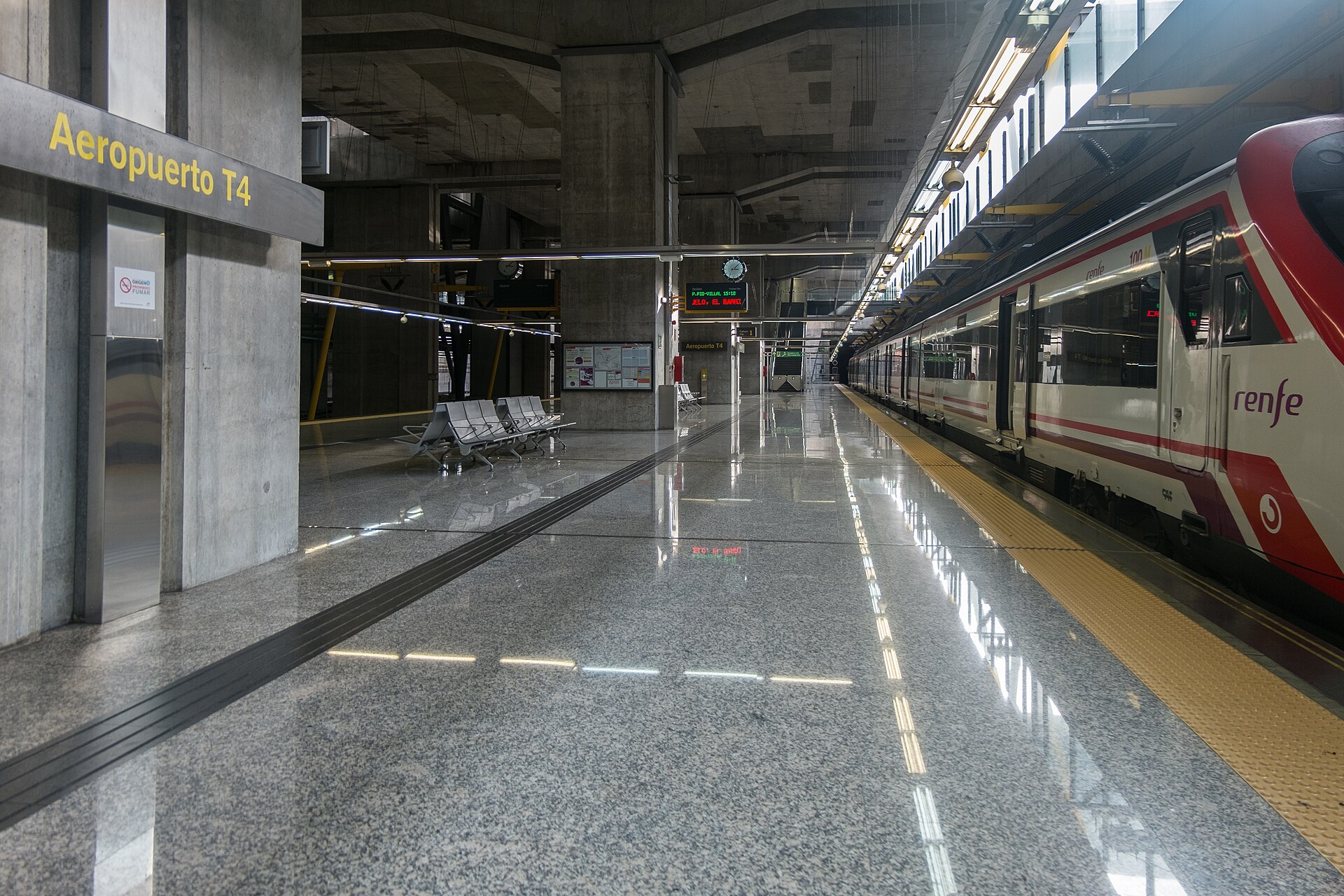
The C1 suburban train leaves from a station beneath T4 and runs to Chamartín in about 19 minutes, Nuevos Ministerios, Recoletos, Atocha in about 33 minutes and on to Príncipe Pío. A single costs around €2.60. Trains are less frequent than the Metro, so check the next departure on the board before you commit. This is the best option from T4 for both of our micro-itineraries: Atocha for the Prado, Príncipe Pío for the Temple of Debod.
From any terminal: Metro Line 8
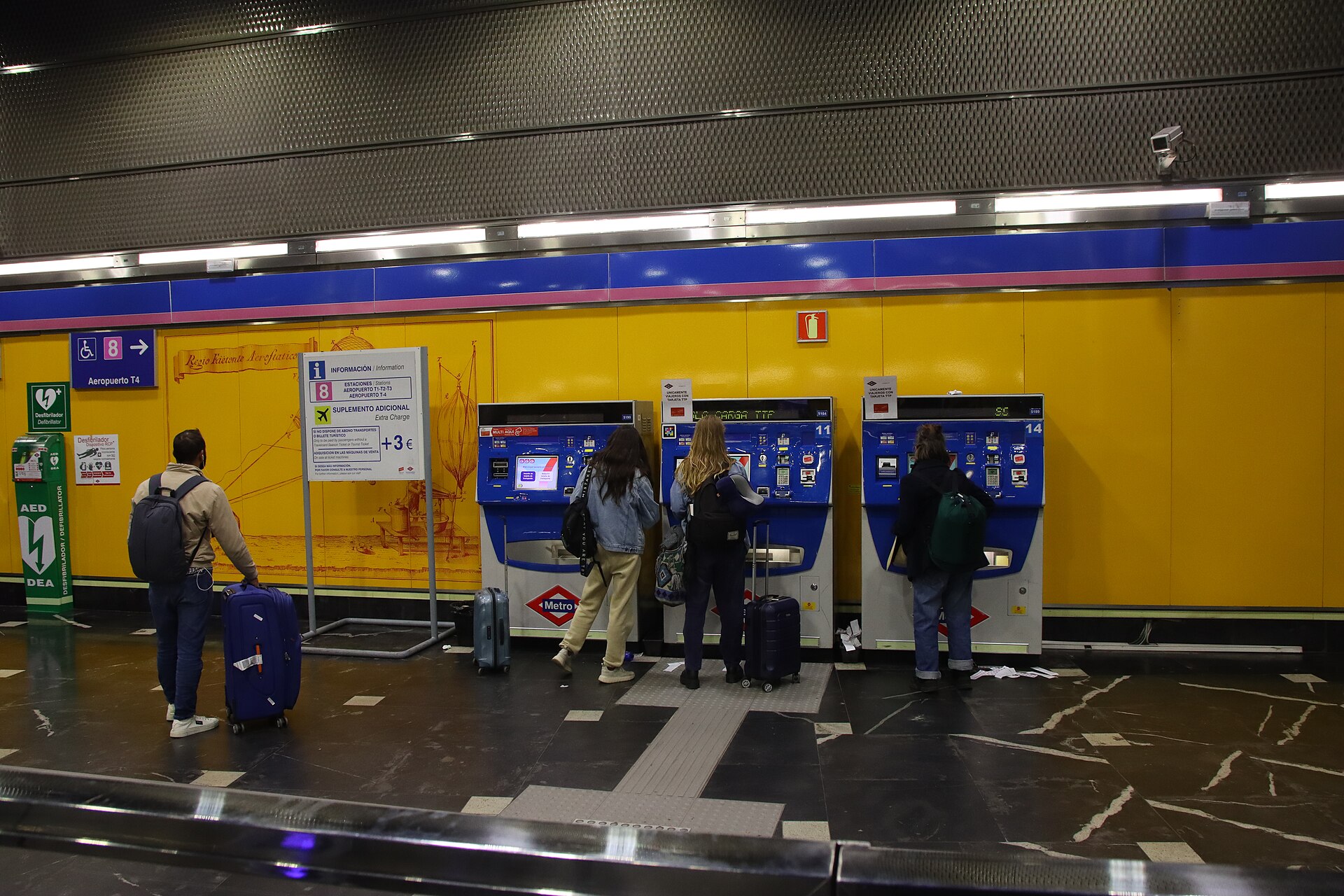
Line 8 runs from Aeropuerto T4 and Aeropuerto T1-T2-T3 to Nuevos Ministerios in about 22 minutes from T4, with frequent trains. From Nuevos Ministerios, change to Line 10 or Line 6, or to the Cercanías, for the centre. A single ticket from the airport costs about €4.50–€5, including the €3 airport supplement. Allow 35 to 50 minutes to Sol, Gran Vía or the Prado.
Taxi
A flat €33 to anywhere inside the M-30 ring road, and back again. It can be faster than the train in light traffic and much slower at rush hour (roughly 07:30–09:30 and from 18:00). For two or more people on a short layover, it removes a lot of friction.
Exprés Aeropuerto bus
Line 203 runs 24 hours from T1, T2 and T4 to Cibeles and Atocha for €5. It is fine for the city but slower than the train, and its journey time depends on traffic. On a layover, we would use it only at night.
Layover Itineraries by Time
Under 4 hours: stay airside
There is no version of a three-hour layover with a trip into town that is not stressful. Make the airport work for you instead.
- Eat properly. Both T4 and T4S have sit-down restaurants serving Spanish food — tortilla, croquetas, jamón and a glass of Rioja — at airport prices.
- Use a lounge. Iberia’s Velázquez (T4) and Dalí (T4S) lounges are available to eligible passengers; Aena’s own VIP lounges accept paid entry and membership programmes.
- Rest. GettSleep pods in T4S, airside, can be booked from three hours, with showers. On a long-haul-to-long-haul connection, a shower and an hour lying down changes the next flight.
- Look at the building. If you are in T4, walk to a window and look up at the roof. It is one of the great pieces of airport architecture.
4 to 5 hours: probably stay
It is technically possible to reach the centre and come back with five hours if both flights are Schengen and you have no checked bags. You would get about an hour and a half in town. Our honest advice is still to stay airside unless you have been to Madrid before, know exactly where you are going, and would be happy to turn back early. A delayed inbound flight turns this plan into a missed connection.
6 hours: one thing, done well
With six hours, pick a single goal close to your train stop. The best choices:
- The Prado: C1 to Atocha, walk ten minutes, an hour with the masterpieces, straight back. See the micro-itinerary below.
- The Paseo del Prado and the Retiro: C1 to Atocha, walk up the Paseo del Prado under the plane trees, into the Retiro through the Puerta de Murillo, and back.
- Chamartín and a proper lunch: if you only want to escape the airport, the C1 to Chamartín and a menú del día in a neighbourhood restaurant nearby is a low-risk option, 19 minutes each way.
8 hours: a real taste of Madrid
With about three hours in town, you can combine one major sight with a meal:
- Prado and lunch: an hour and a half in the Prado, then lunch in Las Letras (Huertas) nearby.
- Old Madrid walk: C1 to Atocha or Metro to Sol; walk Sol → Plaza Mayor → Mercado de San Miguel → Calle Mayor → the Royal Palace and Almudena Cathedral exteriors → the Temple of Debod. Return by C1 from Príncipe Pío. See our guide to Puerta del Sol and Plaza Mayor.
- Royal Palace: if you want to go inside, book a timed ticket in advance — see Royal Palace tickets.
10 to 12 hours: a proper half-day
With six or seven hours in the city, you can do Madrid justice, at least in miniature:
- C1 to Atocha. Prado for two hours in the morning.
- Walk through the Retiro to the Palacio de Cristal.
- Metro or a 25-minute walk to Sol and Plaza Mayor.
- A long lunch of tapas on the Cava Baja in La Latina — see tapas bars in La Latina.
- Walk past the Royal Palace to the Temple of Debod for the view.
- C1 back from Príncipe Pío.
Stay central and resist day trips. Toledo is only 33 minutes from Atocha by train, but by the time you reach the old town and come back, you have used your whole layover on transport and a missed return train would be a disaster.
Overnight layovers
If you land in the evening and leave the next morning, you have a choice between sleep and the city.
- Sleep near your gate: Aerotel in T4 (level −1, landside, 3-, 6- or 12-hour blocks) or GettSleep pods in T4S (airside). Best for very early departures.
- A hotel near the airport with a shuttle: often cheaper than the in-terminal options and quieter — see hotels near Madrid airport.
- Go out for dinner: Madrid eats late, so arriving at 20:00 is perfect. Take the train in, have tapas in La Latina or Las Letras from 21:00, and take a €33 taxi back. The C1 and Metro stop running around midnight to 01:30; after that, the airport bus runs all night and taxis are easy to find.
Micro-Itinerary 1: The Prado in Two Hours
This is the classic layover visit, and it works because the route is simple and the museum is close to the station.

- Train: C1 from T4 to Atocha, about 33 minutes. From T1 or T2, take Line 8 to Nuevos Ministerios and change to the Cercanías for Atocha.
- Walk: from Atocha, walk up the Paseo del Prado for about ten minutes to the Jerónimos or Goya entrance.
- Tickets: buy online in advance for a specific time. General admission is around €15. Entry is free during the last two hours of the day (Monday to Saturday 18:00–20:00, Sundays and holidays 17:00–19:00), but the queue can be long — on a layover, pay.
- What to see in one hour: Velázquez’s Las Meninas; Goya’s The Third of May 1808 and the Black Paintings; Bosch’s Garden of Earthly Delights. Pick up a map at the entrance and go straight to them.
- Coffee: the museum café, or a bar on the streets behind the museum.
- Return: walk back to Atocha and take the C1 to T4.
Opening hours are generally Monday to Saturday 10:00–20:00 and Sundays and holidays 10:00–19:00. The Prado closes on 1 January, 1 May and 25 December. For more, see our Prado Museum guide.
Micro-Itinerary 2: The Temple of Debod and Old Madrid
An outdoor route for people who want to see the city rather than a museum, finishing at one of Madrid’s best viewpoints.
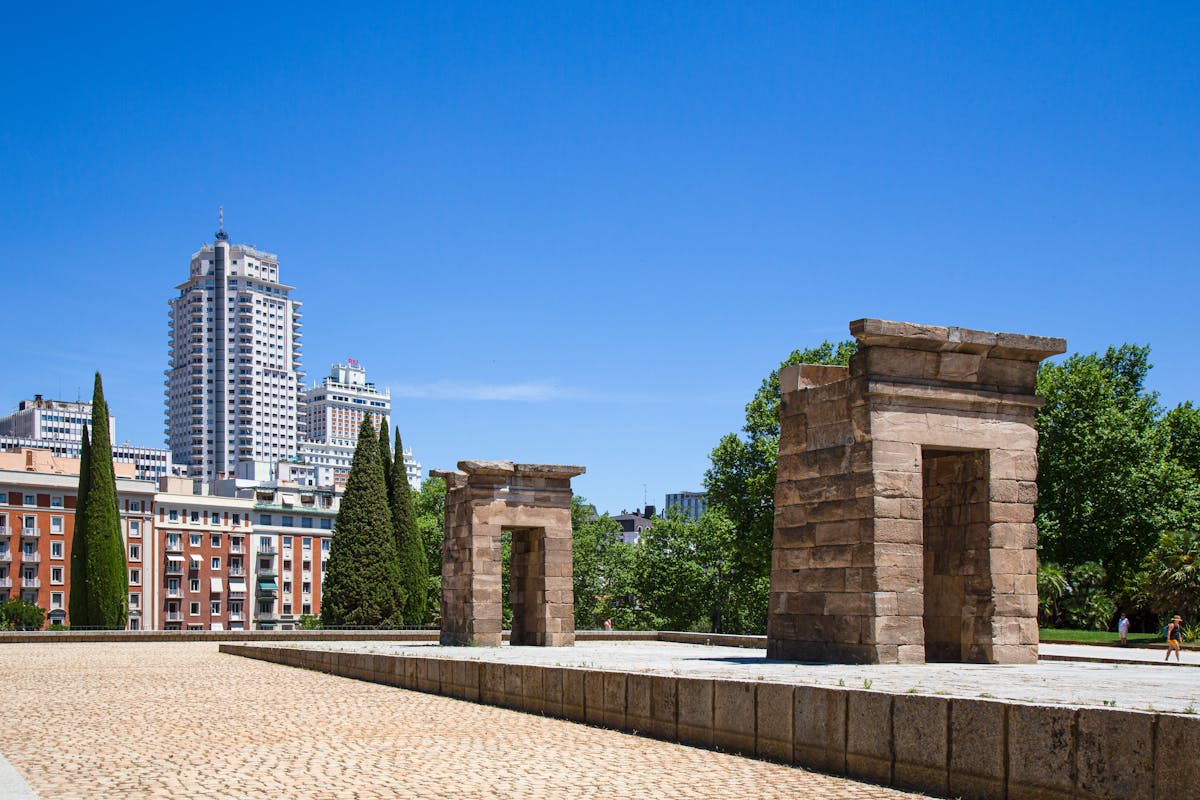
- Train: C1 from T4 all the way to Príncipe Pío, roughly 45 minutes.
- Walk up: from Príncipe Pío, it is about ten minutes uphill to the Parque de la Montaña and the Temple of Debod.
- The temple: the park and the view are open all the time and free. Going inside is free but ticketed: book at madrid.es/debodreservas. Only 30 people are allowed in at once, with a maximum visit of 30 minutes. The temple closes on Mondays, and opens 10:00–20:00 in winter (last entry 19:30) and 10:00–19:00 from 15 June to 15 September (last entry 18:30). On a layover, the outside and the view are enough.
- Walk through old Madrid: down to Plaza de España, along Calle Bailén past the Royal Palace and Almudena Cathedral, then along Calle Mayor to Plaza Mayor and Sol — about 30 to 40 minutes at a stroll, with stops.
- Eat: a bocadillo de calamares near Plaza Mayor, or tapas on the Cava Baja.
- Return: the Cercanías from Sol back towards the airport (change as needed), or walk back to Príncipe Pío for the C1. Allow a full hour for the return journey to T4.
For more on the temple, including the sunset, see our guides to free things to do in Madrid and the top things to see in Madrid.
Staying Airside: Making the Most of Barajas
If the maths says stay, Barajas is one of the better European airports to be stuck in.
- Free, unlimited Wi-Fi throughout — good enough for video calls.
- 24-hour food in T1, T2, T4 and T4S.
- Lounges: Iberia’s Velázquez and Dalí for eligible passengers; Aena VIP lounges for paid access.
- Sleeping pods: GettSleep in T4S, airside, from three hours.
- Shopping: the biggest duty-free is in T4S. Food gifts are cheaper in town, but the choice airside is decent.
- Architecture: T4’s roof and light are genuinely worth an unhurried look.
If you are connecting between T4 and T1 or T2, remember the complexes are not linked airside. You will leave one, take the free bus, and clear security at the other. That transfer is the biggest time sink at Barajas — see our airport guide.
What a Layover in Madrid Costs
| Item | Cost (approx., Sept 2026) |
|---|---|
| C1 train, T4 to the centre, return | About €5.20 |
| Metro Line 8, return, including airport supplements | About €9–€10 |
| Taxi, return, inside the M-30 | €66 |
| Prado ticket | About €15 |
| Temple of Debod | Free (inside is ticketed) |
| Menú del día lunch | About €13–€18 |
| Coffee and pastry | About €3–€5 |
If you are travelling from outside the EU, you will not need cash: contactless cards work on the Metro gates, in taxis and almost everywhere else. Decline any offer to charge you in your home currency.
Layover Mistakes to Avoid
- Forgetting the return security and passport check. Coming back through T4 central security and T4S passport control can take longer than the train ride.
- Ignoring your arrival time. Long-haul arrivals between about 06:00 and 09:00 hit the longest passport queues.
- Going too far. A day trip on a layover is never worth the risk.
- Not checking terminals. A T4 arrival and a T1 departure adds half an hour to both ends.
- Leaving it late at night. After about midnight, rail options disappear; budget for a taxi.
- Dragging a suitcase around the city. Use left luggage or stay airside.
- Assuming the museum is open. Check the day: many smaller museums close on Mondays, the Reina Sofía on Tuesdays, and the Temple of Debod on Mondays.
Frequently Asked Questions
Can I leave Madrid airport during a layover?
Yes, if your passport allows you to enter the Schengen area. EU citizens and many visa-exempt nationalities can leave freely; travellers who need a Schengen visa cannot leave without one.
How many hours do I need to leave the airport in Madrid?
We recommend at least six hours, and eight for a comfortable visit. Under four hours, stay in the terminal.
How long does it take to get from Madrid airport to the city centre?
From T4, the Cercanías C1 takes about 19 minutes to Chamartín and 33 minutes to Atocha. Metro Line 8 takes about 22 minutes to Nuevos Ministerios. Allow 35 to 50 minutes door to door to most central sights.
Is there left luggage at Madrid airport?
Aena lists left-luggage services on the landside in T1 and T4. Check current prices and hours before you rely on them.
What can I see in Madrid on a 6-hour layover?
One thing, close to the train: an hour in the Prado, a walk along the Paseo del Prado and into the Retiro, or lunch near Chamartín.
Can I sleep at Madrid airport on a long layover?
Yes. GettSleep pods in T4S (airside) and the Aerotel transit hotel in T4 (landside) both rent private space by the hour, and the terminals are open 24 hours.
Is Madrid airport good for a long layover?
Yes. It has free unlimited Wi-Fi, 24-hour food, lounges, sleeping pods and a fast rail link to one of Europe’s great museum cities.
Do I need to go through security again after leaving Madrid airport?
Yes. If you leave the airside area, you must clear security again, and passport control too for non-Schengen departures.
Related Madrid Guides
- Madrid Airport: The Complete Guide
- Madrid Airport Terminal 4 and T4S
- Madrid Airport to City Centre
- Hotels Near Madrid Airport
- The Prado Museum
- Top Things to See in Madrid
- Madrid Travel Tips
Photo Credits
Cercanías train at Aeropuerto T4 station: 17-12-14-Flughafen-Madrid-Barajas-RalfR-DSCF0961 by Ralf Roletschek, GFDL 1.2, via Wikimedia Commons.
Metro Line 8 ticket machines at the airport: Estacion de Aeropuerto T1-T2-T3, 2025 (05) by Draceane, CC BY-SA 4.0, via Wikimedia Commons.