Stand on the concourse at Atocha at eight on a weekday morning and you can watch half of Spain leave town: suits heading for a 10:30 meeting in Barcelona, students with rucksacks going home to Valencia, a family with a cool box bound for the beaches of Málaga. Every high-speed line in the country runs out of Madrid like spokes from a hub, which makes trains from Madrid the easiest way to see the rest of Spain, and usually the fastest from city centre to city centre. This page is about the routes, the four operators competing on them, and how to book well. For the stations themselves — layouts, lockers, how to get there — see our separate guide to Madrid’s AVE train stations.
Below you will find every major route with journey times and which station it leaves from, an honest comparison of Renfe AVE, Avlo, Iryo and Ouigo, how far ahead to book and what that saves, what happens at the security check, luggage rules, and the destinations where the train is not the right answer. Prices were checked in September 2026; treat them as the right order of magnitude, because Spanish rail fares are dynamic and the same seat can cost €19 or €89 depending on when you buy it.
Trains from Madrid at a Glance
| Destination | Fastest time (approx.) | Usual Madrid station | Operators | Booked-ahead fare guide |
|---|---|---|---|---|
| Toledo | 33 min | Atocha | Renfe Avant | About €10–€15 one way |
| Segovia | About 30 min | Chamartín | Renfe Avant, AVE, Alvia | About €10–€15 |
| Cuenca | About 55 min | Atocha or Chamartín | Renfe AVE, Alvia | From about €15 |
| Valladolid | About 1 hr | Chamartín | Renfe AVE, Avlo, Alvia, Avant; Ouigo | From about €10 |
| Zaragoza | About 1 hr 15 | Atocha | Renfe AVE, Avlo; Iryo; Ouigo | From about €10 |
| Córdoba | About 1 hr 45 | Atocha | Renfe AVE, Avlo; Iryo; Ouigo | From about €15 |
| Valencia | About 1 hr 45–2 hr | Chamartín or Atocha | Renfe AVE, Avlo; Iryo; Ouigo | From about €10 |
| Alicante | About 2 hr 15 | Chamartín or Atocha | Renfe AVE, Avlo; Iryo; Ouigo | From about €15 |
| Seville | About 2 hr 30 | Atocha | Renfe AVE, Avlo; Iryo; Ouigo | From about €28 on AVE, less on low-cost |
| Barcelona | About 2 hr 30 | Atocha (some from Chamartín) | Renfe AVE, Avlo; Iryo; Ouigo | From about €15–€35 |
| Málaga | About 2 hr 30 | Atocha | Renfe AVE, Avlo; Iryo; Ouigo | From about €20 |
| Santiago de Compostela | About 3 hr | Chamartín | Renfe AVE, Avlo, Alvia | From about €20 |
| Oviedo | About 3 hr 15 | Chamartín | Renfe AVE, Avlo, Alvia | From about €20 |
| Granada | About 3 hr 15 | Atocha | Renfe AVE | From about €25 |
| Bilbao / San Sebastián | About 5 hr | Chamartín | Renfe Alvia | From about €25; often slower than the bus or a flight |
| Lisbon | No direct train | — | — | Fly or take the bus |
Times are for the fastest direct trains; many services on the same route stop more and take 20 to 40 minutes longer. Fares are cheap advance fares for a standard seat and are a guide, not a quote. Walk-up prices on the busy routes are often three or four times higher.
The Two Stations: Atocha and Chamartín
Almost every long-distance train from Madrid leaves from one of two stations, and the most useful habit you can build is reading the station name on your ticket twice.
- Puerta de Atocha-Almudena Grandes — still “Atocha” to everyone — sits at the bottom of the Paseo del Prado, walking distance from the Prado, the Reina Sofía and the Retiro. It is the traditional terminus for the south and east: Seville, Córdoba, Málaga, Granada, Barcelona, Zaragoza, and the Avant shuttle to Toledo.
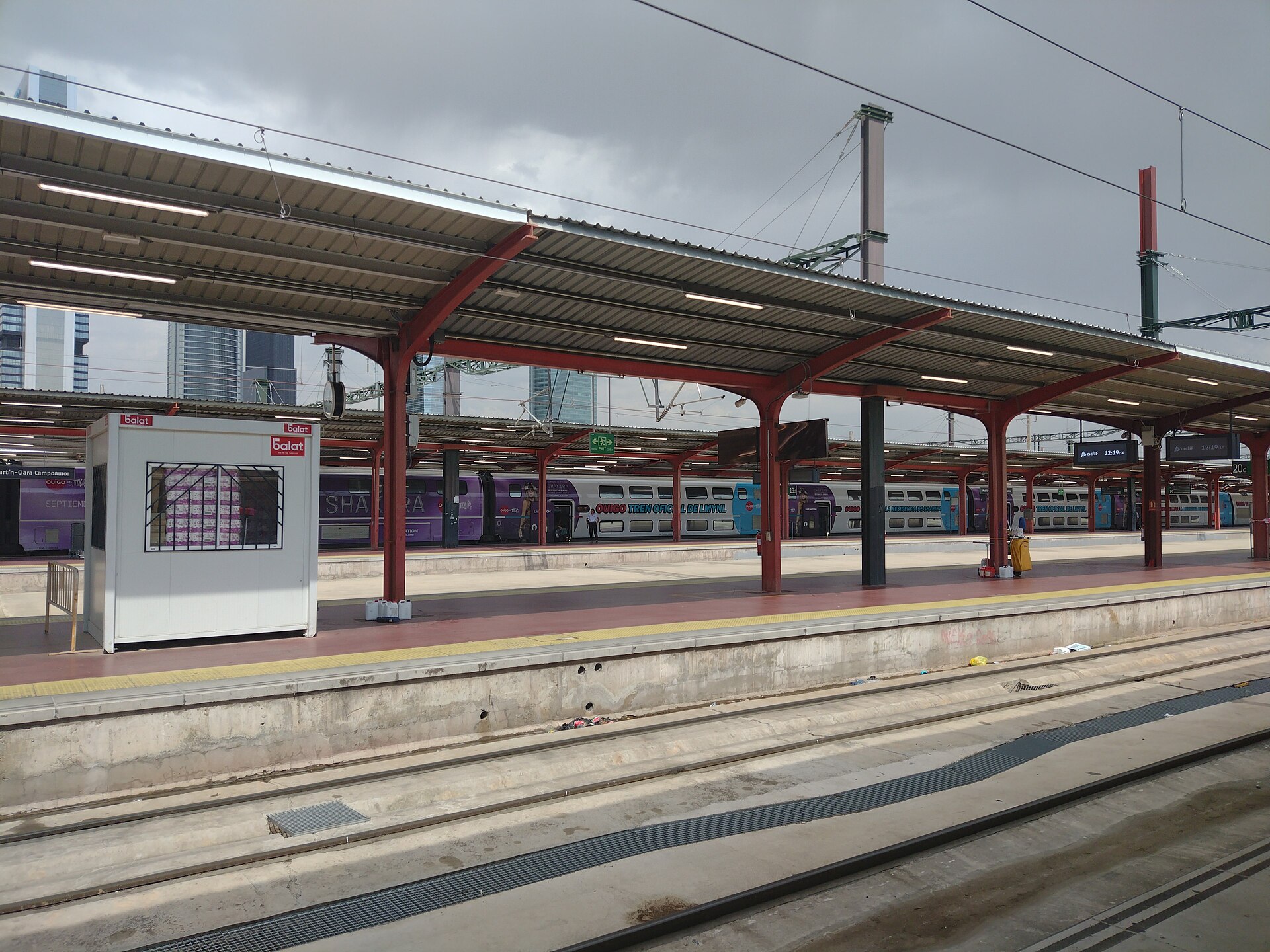
- Chamartín-Clara Campoamor is in the north of the city, beside the Cuatro Torres skyscrapers. It serves the north and north-west — Segovia, Valladolid, León, Asturias, Galicia, the Basque Country — and, since the rail tunnel between the two stations opened to high-speed traffic, a growing number of trains to Valencia, Alicante and Murcia.
That tunnel has made things more flexible and slightly more confusing. Some routes that always started at Atocha now start at Chamartín, or run through both, and the pattern differs by operator. Ouigo and Iryo do not always use the same station as Renfe on the same route. If you are staying near Sol, the difference between the two is about 15 minutes on the Cercanías — not a disaster, but not something to discover at the ticket gate with four minutes to spare.
The two stations are linked by frequent Cercanías trains through the city-centre tunnel (Sol, Nuevos Ministerios and Recoletos are all on the way), in roughly 12 to 15 minutes. Many long-distance Renfe tickets include a free Cercanías journey to or from the station on the same day — look for the combinado Cercanías code on your ticket. The full picture on getting to each station, where the taxi ranks are, where to eat, and where you can and cannot leave luggage is in our Madrid train stations guide.
The Operators: AVE, Avlo, Iryo and Ouigo
For most of its history Spanish high-speed rail meant one company: Renfe. Since the market opened in 2021, the main corridors out of Madrid have three competing brands running on the same track, and prices on those routes have fallen sharply. Here is how they differ in practice.
Renfe AVE
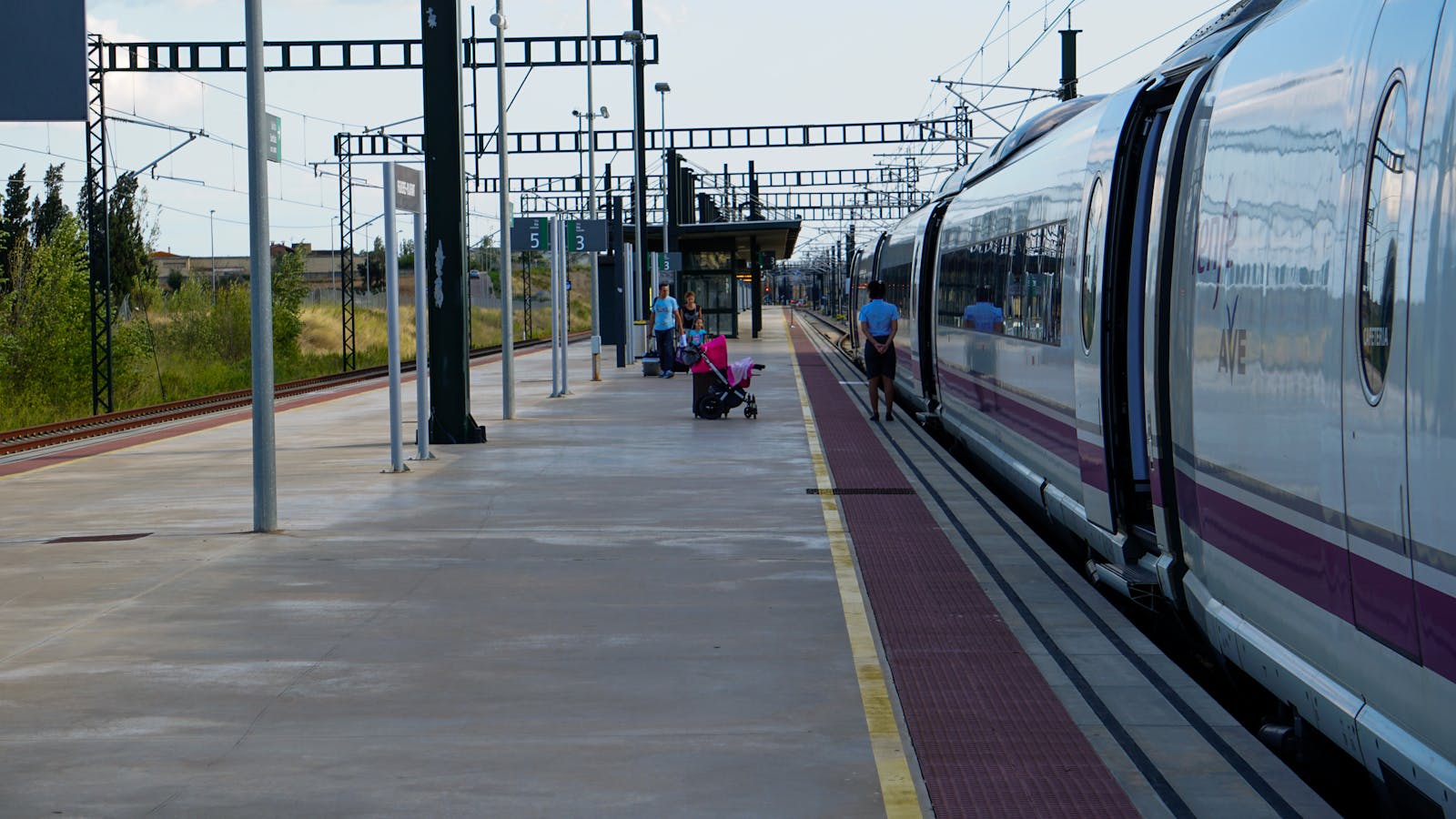
The original, full-service high-speed brand. AVE covers the widest network by far, runs the most frequencies, and is usually the only high-speed option to Granada, Galicia, Asturias, León and several smaller cities. Standard (Estándar) fares include a reasonable luggage allowance; Confort gives you a wider seat in a 2+1 layout, and on some fares a snack or meal. There is a café car on most trains. It is the most expensive of the four on the competitive routes when booked late, and often not much more expensive when booked early — it is worth comparing.
Renfe Avlo
Renfe’s own low-cost brand, using high-speed trains with a single class and no café car (vending machines instead). The base fare includes a small cabin bag and a personal item; bigger luggage, seat selection and flexibility cost extra. Avlo runs to Barcelona, Valencia, Alicante, Andalusia and, more recently, Galicia and Asturias. Its promotional fares at launch were famously as low as €7 on some routes; typical advance fares are higher than that, but still frequently under €30.
Iryo
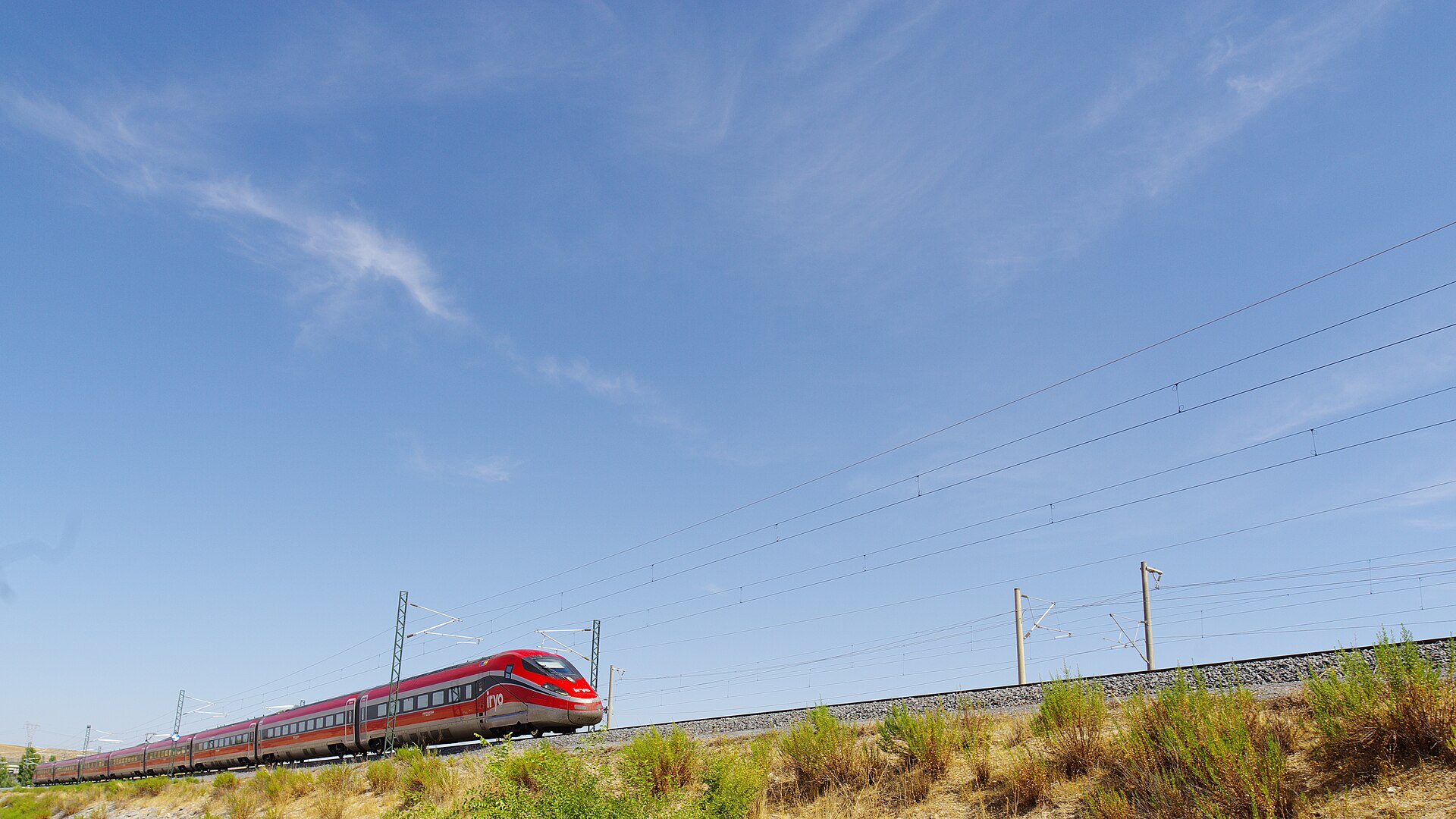
The Italian-backed operator, running red Frecciarossa 1000 trains. Iryo has three classes (Inicial, Singular and Infinita), a proper café bar, and the most comfortable standard-class seat of the low-cost challengers. It runs Madrid to Barcelona, Zaragoza, Valencia, Alicante, Córdoba, Seville and Málaga. If you want AVE-level comfort for a lower price on one of those routes, Iryo is often the sweet spot.
Ouigo
The SNCF-owned low-cost operator, using double-decker TGV trains, which means a lot of seats and often the lowest fares. The basic ticket includes one cabin bag and one small bag; anything else is an add-on, bought online in advance for much less than on the day. Ouigo runs Madrid to Barcelona, Zaragoza, Valencia, Alicante, Andalusia and Valladolid/Segovia. The upper deck has the better views. There is a small café counter; the experience is more budget airline than grand rail journey, but the trains are fast, punctual and cheap.
| Renfe AVE | Renfe Avlo | Iryo | Ouigo | |
|---|---|---|---|---|
| Network from Madrid | Everywhere with high-speed track | Main corridors plus Galicia and Asturias | Barcelona, Valencia, Alicante, Andalusia | Barcelona, Valencia, Alicante, Andalusia, Valladolid |
| Classes | Estándar, Confort, Prémium on some fares | One class | Inicial, Singular, Infinita | Essential, with Plus options |
| Food | Café car | Vending | Café bar | Small café counter |
| Luggage in basic fare | Generous | Small bag and personal item | Cabin bag and personal item on the entry fare | Cabin bag and small bag |
| Best for | Flexibility, frequency, routes nobody else runs | Cheap travel with a small bag | Comfort at a good price | Lowest headline fares |
A word on luggage, because it is where low-cost fares stop being low-cost. On Avlo and Ouigo especially, check the size limits before you book and add a large case online if you have one. Staff at the boarding gate do check. A €9 fare with a €20 bag charge is still a good deal to Barcelona, but it is not a €9 fare.
Other Renfe services you will see on the board
- Avant — short-distance high-speed shuttles on commuter routes such as Madrid–Toledo, Madrid–Segovia and Madrid–Valladolid. Cheap, fast and frequent; seats are reserved.
- Alvia — trains that run on high-speed track for part of the way and then continue on conventional lines, which is how Bilbao, San Sebastián, Salamanca, Santander and Cádiz are served.
- Intercity and Media Distancia — regional and conventional long-distance trains. Slower, sometimes very scenic, and occasionally the only option.
- Cercanías — the suburban network, which is how you reach El Escorial, Alcalá de Henares and Aranjuez. Explained in our Madrid Cercanías guide.
The Routes, One by One
Madrid to Barcelona
The busiest high-speed route in Spain and one of the busiest in Europe. The fastest non-stop trains take about two and a half hours; most stop at Zaragoza and some at Guadalajara, Calatayud or Lleida, and take closer to three. All four brands compete, so there are departures roughly every half hour through the day. Most trains leave Atocha; some leave Chamartín. In Barcelona they arrive at Sants, which is on the Metro and a short ride from the centre.
Is it better than flying? For almost everyone, yes. Once you count getting to Barajas, security and getting in from El Prat, the plane takes four hours door to door and the train takes three. The one case for flying is a very cheap fare combined with staying near either airport.
Madrid to Seville
The line that started it all in 1992. The fastest direct AVE from Atocha to Sevilla Santa Justa takes about two hours and thirty minutes over roughly 390 kilometres, and there are more than twenty trains a day. Walk-up fares on AVE can be high — €75 or more for a standard seat — while the same seat booked a month or two ahead is often below €30, and the low-cost operators can go lower. Most trains stop at Córdoba, and some also at Ciudad Real and Puertollano.
Madrid to Córdoba
About an hour and forty-five minutes, on the Seville and Málaga lines, which means a lot of trains. Córdoba is the best high-speed day trip beyond the Madrid region: leave Atocha before 09:00, see the Mezquita-Catedral and the old Jewish quarter, eat salmorejo, and be back for a late dinner. It is a long day, but a good one.
Madrid to Málaga
About two and a half hours for the fastest trains, to Málaga María Zambrano, which is a ten-minute walk from the old town. The line branches off the Seville route after Córdoba and runs through Antequera. This is how most people from Madrid get to the Costa del Sol; with a hire car from Málaga, it is also the best way to reach Ronda and the white villages.
Madrid to Granada
High-speed service arrived in Granada in 2019, and the fastest trains now take a little over three hours. The line is not as fast as the others in its final stretch. There are fewer daily departures than to Seville or Málaga, and it is mostly Renfe, so book early, especially if you are also trying to get Alhambra tickets for a specific day.
Madrid to Valencia
One hour forty-five to two hours to Valencia Joaquín Sorolla. Frequent departures from four brands, and some of the lowest fares in the country when booked ahead. Renfe services now mostly run from Chamartín through the tunnel; others still use Atocha. Joaquín Sorolla is a short shuttle or 20-minute walk from the old centre. If Valencia is your only other stop, a weekend there is very easy.
Madrid to Alicante and Murcia
Alicante is about two and a quarter hours away on the fastest trains, with competition from all the operators. Murcia got its high-speed connection in late 2022, and trains take roughly three hours. Both are the practical way to reach the Costa Blanca without flying.
Madrid to Zaragoza
An hour and a quarter or so, on the Barcelona line, with trains constantly. Zaragoza is underrated — the Basílica del Pilar, the Aljafería palace and a very good tapas scene — and works as a day trip or as a stop on the way to Barcelona.
Madrid to Toledo
The Avant shuttle from Atocha takes about 33 minutes. It is the obvious choice for a day trip, with two caveats: trains sell out on weekends and holidays, so book your return in advance; and Toledo station is a lovely neo-Mudéjar building a steep 20-minute walk (or a short bus ride) below the old town. The day itself is covered in our Toledo day trip guide.
Madrid to Segovia
About half an hour on the high-speed line from Chamartín to Segovia-Guiomar, which is outside the town; a local bus takes you the remaining few kilometres to the Roman aqueduct in about 15 minutes. This is often faster than the direct bus from Moncloa, which drops you by the aqueduct but takes around an hour and a quarter. For a longer day, see our Segovia day trip guide.
Madrid to Cuenca
High-speed trains reach Cuenca Fernando Zóbel in under an hour. That station, too, is outside the town, so allow for a bus up to the hanging houses. Our Cuenca day trip guide has the details.
Madrid to Valladolid, León and Salamanca
Valladolid is about an hour from Chamartín on the high-speed line to the north. León is roughly two hours. Salamanca is not on the high-speed network proper; Alvia services take about an hour and a half, and the bus is competitive.
Madrid to Galicia
The high-speed line to Galicia was completed through the mountains in 2021, and it changed the journey entirely. Santiago de Compostela is now about three hours from Chamartín on the fastest trains, A Coruña a little more, and Vigo and Pontevedra roughly four. For pilgrims starting or finishing the Camino, this is a very good option. Avlo runs on the route too.
Madrid to Asturias
The Pajares base tunnel opened to passenger trains in late 2023, cutting the trip to Oviedo and Gijón to around three hours and a quarter. Renfe runs around eight trains a day to Oviedo, including Avlo services. The views over the Cantabrian mountains after León are spectacular, which is a good reason to take a window seat on the left heading north.
Madrid to Bilbao, San Sebastián and Santander
This is where the network stops being fast. The high-speed line to the Basque Country is not finished, so these cities are served by Alvia trains that take around five hours to Bilbao or San Sebastián and a little less to Santander. Frequencies are low. For Bilbao especially, a one-hour flight from Barajas or the ALSA bus (roughly the same time as the train, often cheaper) are worth comparing. This is one of the few big Spanish routes where the train is not an automatic choice.
Madrid to Cádiz and Huelva
Cádiz is reached on Alvia services that use the high-speed line to Seville and then continue on conventional track; allow about four hours. Huelva has similar Alvia connections. Neither is quick, but both beat driving.
International Trains from Madrid
Madrid to Lisbon
There is no direct train between Madrid and Lisbon, and there has not been one since the overnight Lusitania sleeper was withdrawn in 2020. The high-speed link is under construction on both sides of the border, but it is years from being a real journey. Any rail routing today takes around ten hours with several changes. Fly — about an hour and a quarter gate to gate, with flights roughly every hour — or take a direct FlixBus, which takes about seven hours and ten minutes and costs very little.
Madrid to Paris and the rest of France
There is no direct Madrid–Paris train either. The practical route is high-speed to Barcelona and then the TGV from Barcelona Sants to Paris Gare de Lyon, roughly six and a half hours, for a total of around ten hours including a sensible connection. Renfe also runs services from Barcelona into southern France, to Marseille and Lyon. It is a lovely way to travel if you have the day, and it is always worth pricing as two separate tickets. If you are trying to get to Paris quickly, fly.
Madrid to Porto
Same answer as Lisbon: no sensible train. A flight takes an hour and a quarter; a bus, around eight hours.
Booking Tickets
Where to buy
- Directly from each operator — renfe.com (for AVE, Avlo, Avant, Alvia and everything else Renfe), iryo.eu and ouigo.com. All have English-language sites and apps, and all accept foreign cards. Buying direct gives you the simplest path when something goes wrong.
- Comparison and resale sites such as Trainline show all operators side by side, which is genuinely useful on the competitive routes. They add a booking fee, and changes and refunds go through them rather than the railway.
- At the station — ticket machines and staffed offices at Atocha and Chamartín. Fine for Cercanías and Avant, not a good idea for a long-distance trip on a busy day.
A tip when searching on the Renfe site: choose “Madrid (Todas)” as your origin rather than a specific station. It will show you trains from both Atocha and Chamartín, which avoids missing a cheaper or faster departure from the station you did not think of.
How far ahead to book
This is the question that saves the most money. Spanish rail fares are dynamic: the cheapest seats sell first, and prices climb as the train fills. Booking one to two months ahead is usually where the good fares are on Renfe; low-cost brands often release cheap seats further out. Renfe’s release of new timetables is irregular, and it is not unusual for bookings to be open only a month or two ahead on some routes, and much further on others. If you search and find nothing, the train is probably not on sale yet rather than full — check again in a week.
The difference is real. Madrid–Seville on AVE can be around €28 booked ahead and €75 or more on the day. On Madrid–Barcelona the gap on a Friday afternoon can be larger still.
The Spain Pass
Renfe sells a Spain Pass for non-residents, valid for 4, 6, 8 or 10 one-way journeys on long-distance and high-speed trains within a month, with seat reservations included. It makes sense if you are taking several long, expensive journeys at short notice — Madrid to Seville, Seville to Granada, Granada to Barcelona, Barcelona back to Madrid, for instance. If you can book a couple of months ahead, individual advance fares will usually beat it. Do the sums on the actual trains you want before you buy. Interrail and Eurail passes are accepted on Renfe trains too, but you will need to pay for a seat reservation, and the low-cost operators do not accept them at all.
Changes and refunds
The cheapest fares on every operator come with the tightest conditions: no refund, and changes for a fee or not at all. Flexible fares cost more. If there is any doubt at all about your plans, the price of a flexible fare can be cheaper than buying a second ticket. When Renfe cancels or significantly delays your train, you are entitled to rebooking or compensation, and delays over a set threshold on AVE earn partial refunds — claim through the operator, not the reseller, where you can.
On the Day: Security, Boarding and the Journey
Security checks
Every high-speed and long-distance train in Spain departs from a controlled area. Before you reach the platform, your bags go through an X-ray scanner, much like at an airport, though without the liquid restrictions and without taking your shoes off. It is usually quick, but on a Friday afternoon at Atocha there can be a queue.
How early to arrive
Twenty to thirty minutes before departure is enough on most days. Boarding closes a couple of minutes before departure, and the gates to the platform are shut at that point, not when the train pulls out. Add time if you are unfamiliar with the station, travelling with young children, or leaving from Atocha during the long rebuild, when some routes to the platforms have changed.
Boarding
Your ticket shows the coach (coche) and seat (plaza). The departure board shows the platform (vía) around 15 to 20 minutes before departure. Scan your ticket at the gate, follow the coach numbers along the platform, and find your seat. Luggage goes on the overhead racks or in the stacks at the end of each carriage.
On board
High-speed trains in Spain are quiet, clean and comfortable. Most have power sockets at the seat and Wi-Fi of variable quality. Many Renfe trains have designated quiet coaches. Eating your own food is completely normal; a bocadillo from a bakery near the station beats the café car on both price and quality. Journeys on the main lines are remarkably punctual.
Travelling with Children, Reduced Mobility or a Pet
Children
Spanish trains are about as easy as travel with small children gets. There is room to walk up and down, toilets that are not the size of a cupboard, and no seatbelt sign. Children under four travel free on most Renfe services if they do not occupy a seat, and discounted child fares apply up to 13 on Renfe; the low-cost operators have their own rules, so check at booking. Book seats together at the time of purchase — on the cheapest fares, seat selection is a paid extra and the system does not always keep a family together by default. The security scanner handles buggies without fuss, and there is space for a folded pushchair in the luggage stacks.
Reduced mobility
Renfe runs a free assistance service called Atendo at the main stations, including Atocha and Chamartín, for anyone who needs help getting to the platform and on and off the train. It covers wheelchair users and also older travellers or anyone who struggles with long distances, stairs or luggage. Request it when you book or by contacting Renfe well in advance — ideally 48 hours before travel. Most high-speed trains have wheelchair spaces and an adapted toilet; book the wheelchair space specifically rather than a standard seat. Iryo and Ouigo offer their own assistance, requested through their own channels. For getting to the stations, see our guide to wheelchair-accessible transport in Madrid.
Pets
Small dogs and cats in a carrier are generally allowed on high-speed trains for a fee, and Renfe has extended the rules to allow larger dogs on some services with a dedicated ticket. Each operator sets its own weight limits and charges, and those rules have changed several times recently, so check on the operator’s own site before you book.
Three Rail Trips That Start in Madrid
If you have more than a few days, Madrid makes a natural base for a longer rail trip. Three routes we like, all realistic on high-speed trains without any backtracking that wastes a day:
Andalusia in a week
Madrid to Córdoba (about 1 hour 45), two nights. Córdoba to Seville (about 45 minutes), three nights. Seville to Granada (the train takes around two and a half hours; the bus is competitive), two nights. Granada back to Madrid (a little over three hours). The one thing to arrange before anything else is the Alhambra ticket, which sells out weeks ahead and should decide your Granada dates.
Madrid, Valencia and Barcelona
Madrid to Valencia (under two hours), two or three nights. Valencia to Barcelona on the coastal line, which is not fully high-speed — roughly three to three and a half hours, with the sea on your right. Barcelona back to Madrid (two and a half hours) or fly home from Barcelona. This works beautifully in May, June, September and October.
Green Spain
Madrid to León (about two hours), one night for the cathedral’s stained glass. León to Oviedo through the Pajares tunnel, two nights. From Oviedo you can reach Santiago de Compostela by a slower combination of trains or the bus, and Santiago to Madrid is a three-hour high-speed run home. It is a completely different country from the one most visitors see.
When the Train Is Not the Answer
Spain’s high-speed network is superb, but it does not reach everywhere, and it is worth being honest about where something else wins.
- Lisbon and Porto. No direct train. Fly or take the bus.
- Bilbao and San Sebastián. Five hours on Alvia. A flight is faster and the bus is often cheaper.
- Anywhere in the Sierra de Guadarrama or small villages near Madrid. The Cercanías or a regional bus, or a hire car. Our best day trips from Madrid guide shows how to reach each.
- Ávila. Not on the high-speed network. The regional train and the bus take about the same time; see the Ávila day trip guide.
- The Balearic and Canary Islands. This one is obvious, but people do ask.
- Last-minute trips on popular routes at peak times. If the cheapest seat left on a Friday Madrid–Barcelona train is €120, a flight or even a comfortable ALSA bus may be much cheaper.
Day Trips by Train from Madrid
High-speed rail puts a remarkable number of historic cities within an easy day of Madrid. The short list, in order of how easy they are:
- Toledo — 33 minutes from Atocha. The classic.
- Segovia — about 30 minutes from Chamartín plus a local bus.
- Alcalá de Henares — Cervantes’s birthplace, 35 to 40 minutes on the Cercanías. See our Alcalá de Henares day trip guide.
- Aranjuez — the royal palace and gardens, 45 minutes on the Cercanías C3. See the Aranjuez day trip guide.
- Cuenca — under an hour on the high-speed line.
- Valladolid — an hour, a very good museum of sculpture and serious food.
- Córdoba — an hour and 45 minutes. A long day, but one of the best in Spain.
Everything else — Seville, Valencia, Barcelona, Granada — is technically possible as a day trip and not a good idea. Two and a half hours each way is five hours on a train; give them at least a night.
Frequently Asked Questions
Which Madrid station do trains to Barcelona leave from?
Most leave from Atocha (Puerta de Atocha-Almudena Grandes), but some services now depart from Chamartín. Always check the station printed on your ticket.
What is the difference between AVE and Avlo?
Both are Renfe high-speed trains on the same track at the same speed. AVE is the full-service brand with more luggage included, a café car and more classes; Avlo is the low-cost version with a single class, a smaller included bag and paid extras.
Is Iryo or Ouigo better?
Iryo is more comfortable, with a proper café and nicer seats; Ouigo is usually a bit cheaper and uses double-decker trains with more seats. On the same route and date, compare both, and add your luggage before you compare.
How early should I get to the station in Madrid?
Twenty to thirty minutes before departure for a high-speed or long-distance train. There is an X-ray bag check, and boarding closes a couple of minutes before the train leaves.
Can I take a direct train from Madrid to Lisbon?
No. There is no direct train. Fly in about an hour and a quarter, or take a direct bus in about seven hours.
Is the Spain Pass worth it?
Only if you are making several long journeys and cannot book them far ahead. Advance fares bought a month or two out are usually cheaper per trip.
Do I need to print my ticket?
No. A mobile ticket with a QR code is accepted by all the operators.
Can I bring food and drink on Spanish trains?
Yes. Bringing your own food and drink, including a bottle of wine with lunch, is normal and allowed.
What is the fastest train from Madrid?
The non-stop services to Barcelona and Seville, both about two and a half hours, run at up to 300 km/h. Toledo, at 33 minutes, is the quickest trip from Madrid to another historic city.
Related Madrid Guides
- Madrid’s AVE Train Stations: Atocha and Chamartín
- Madrid Cercanías Trains
- Best Day Trips from Madrid
- Toledo Day Trip from Madrid
- Segovia Day Trip from Madrid
- Madrid Airport: The Complete Guide
- Madrid Transportation Guide
- How to Save Money in Madrid
Photo Credits
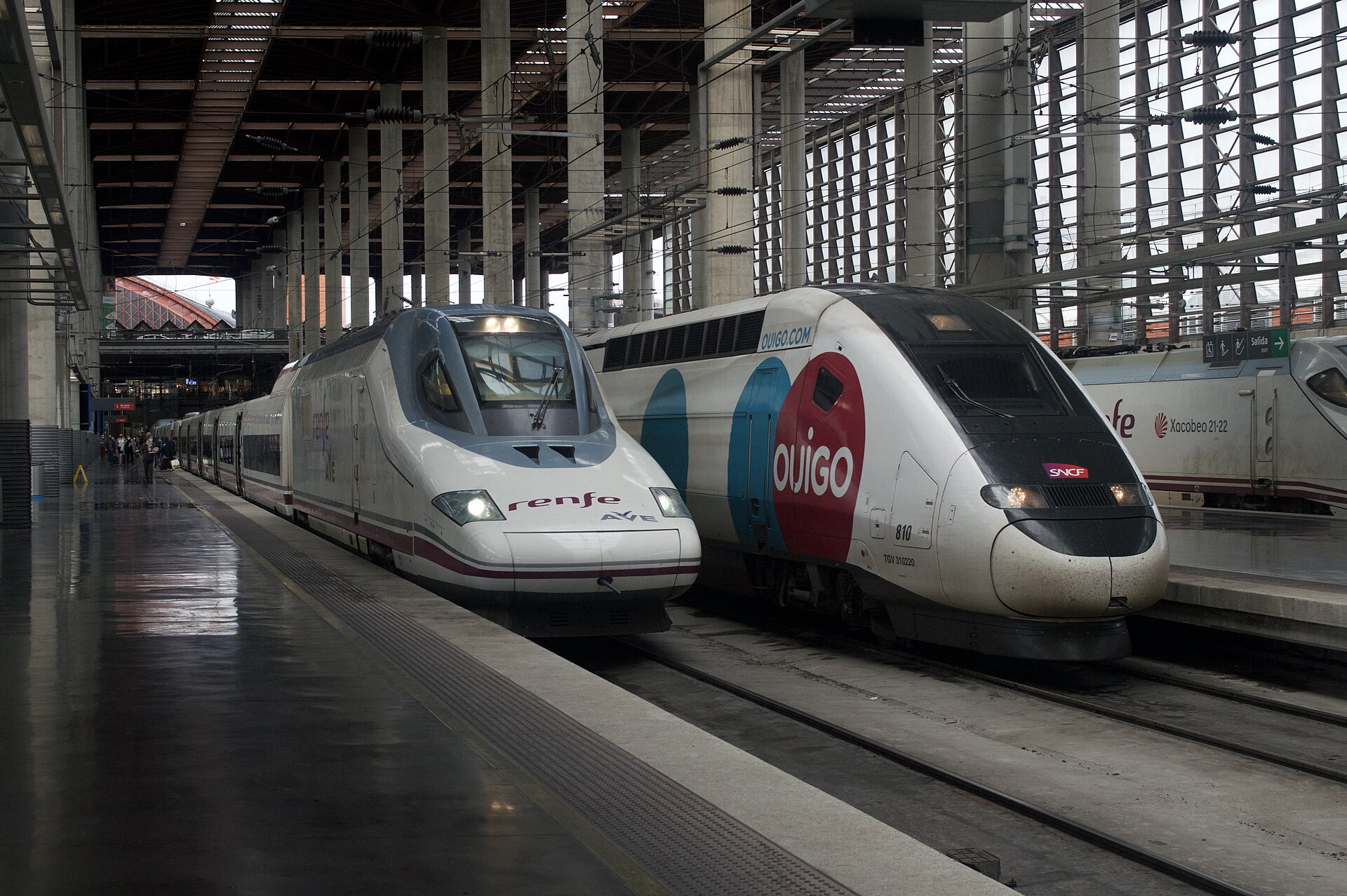
Renfe AVE and Ouigo trains at Puerta de Atocha: 2021-10-31 – Madrid-Puerta de Atocha 112041 and TGV810 – 51666494662 by Phil Richards, CC BY-SA 2.0, via Wikimedia Commons.
Iryo Frecciarossa 1000 near the Manzanares: Iryo Class 109 – Frecciarossa 1000 – Parque Lineal del Manzanares – Section II – Madrid 01 by Javier Perez Montes, CC BY-SA 4.0, via Wikimedia Commons.
Platforms at Chamartín-Clara Campoamor: Estación de Madrid-Chamartín-Clara Campoamor (2026-08-14) by Sneeuwvlakte, CC BY-SA 4.0, via Wikimedia Commons.