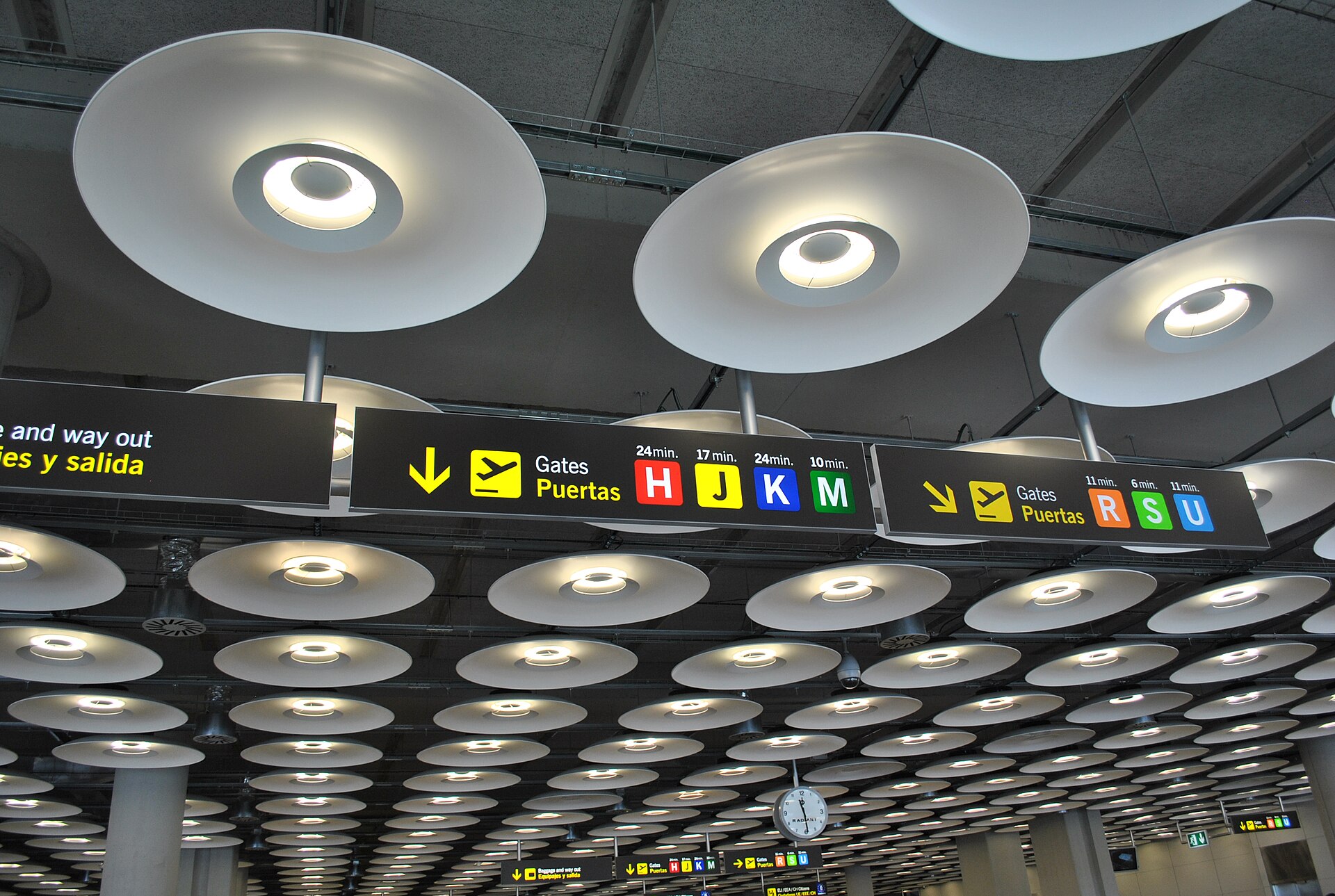
The overhead signs in Terminal 4 give walking times to the gates, and it is the numbers that get people: 17 minutes to J, 24 minutes to K. Add a train ride under the apron to the satellite, and a passport check at the other end, and the building starts to feel less like an airport terminal and more like a small town. Madrid airport Terminal 4 — T4 and its satellite T4S — is Iberia’s home and the hub for the oneworld alliance in Madrid, and it handles most of the airport’s long-haul flights. This page is the detailed guide to that one building: its layout, how long each step takes, arrivals, departures and connections. For the airport as a whole, including T1, T2 and T3, see our complete Madrid airport guide; for getting into the city, see Madrid airport to the city centre.
Everything below was checked in September 2026. Airlines move between terminals, and transport fares change most Januaries, so treat prices as the right order of magnitude and confirm your terminal on your booking before you travel.
Terminal 4 at a Glance
| What | Detail |
|---|---|
| Buildings | T4 (main terminal) and T4S (satellite), linked by an underground automated train, about 3 minutes |
| Main airlines | Iberia, Iberia Express, Air Nostrum and oneworld partners, plus other long-haul carriers |
| Gates | T4: H, J and K. T4S: M (Schengen) and R, S and U (non-Schengen) |
| Passport control for departures | In T4S, after the train, before the R, S and U gates |
| Rail links | Cercanías C1 (T4 only) and Metro Line 8, both below the terminal |
| Airport bus | Exprés Aeropuerto line 203, €5, 24 hours |
| Taxi | €33 flat fare to anywhere inside the M-30 |
| Iberia lounges | Velázquez (T4, Schengen) and Dalí (T4S, non-Schengen) |
| Sleeping | Aerotel (T4, level −1, landside) and GettSleep pods (T4S, airside) |
| Distance to T1/T2 | About 3 km by road; free inter-terminal bus, allow 20–30 minutes |
The Building
Terminal 4 opened in 2006. It was designed by Richard Rogers’s practice with the Spanish firm Estudio Lamela, and it won the RIBA Stirling Prize, Britain’s most important architecture award, that year. It is worth a moment of your attention even if you are rushing.
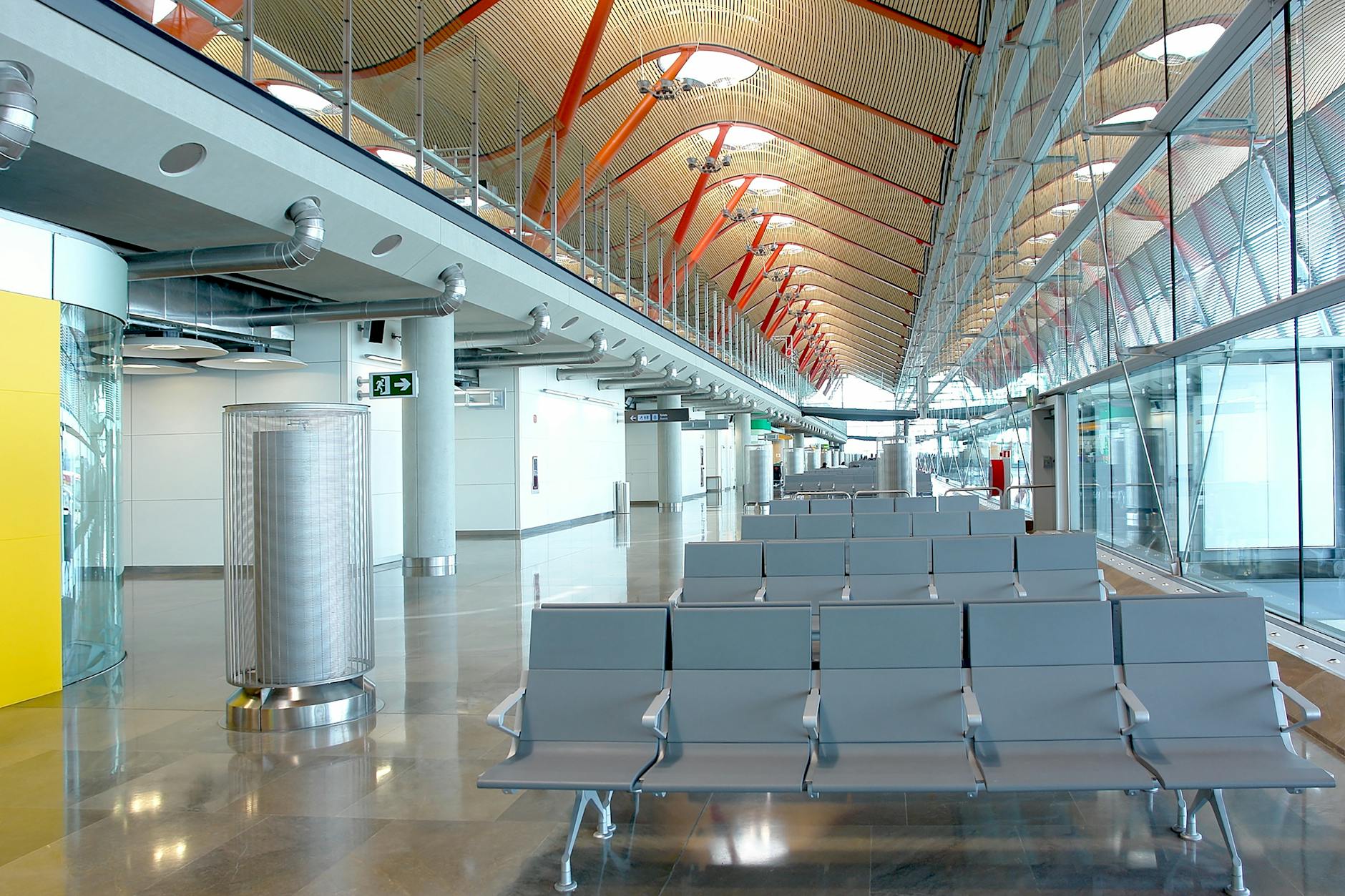
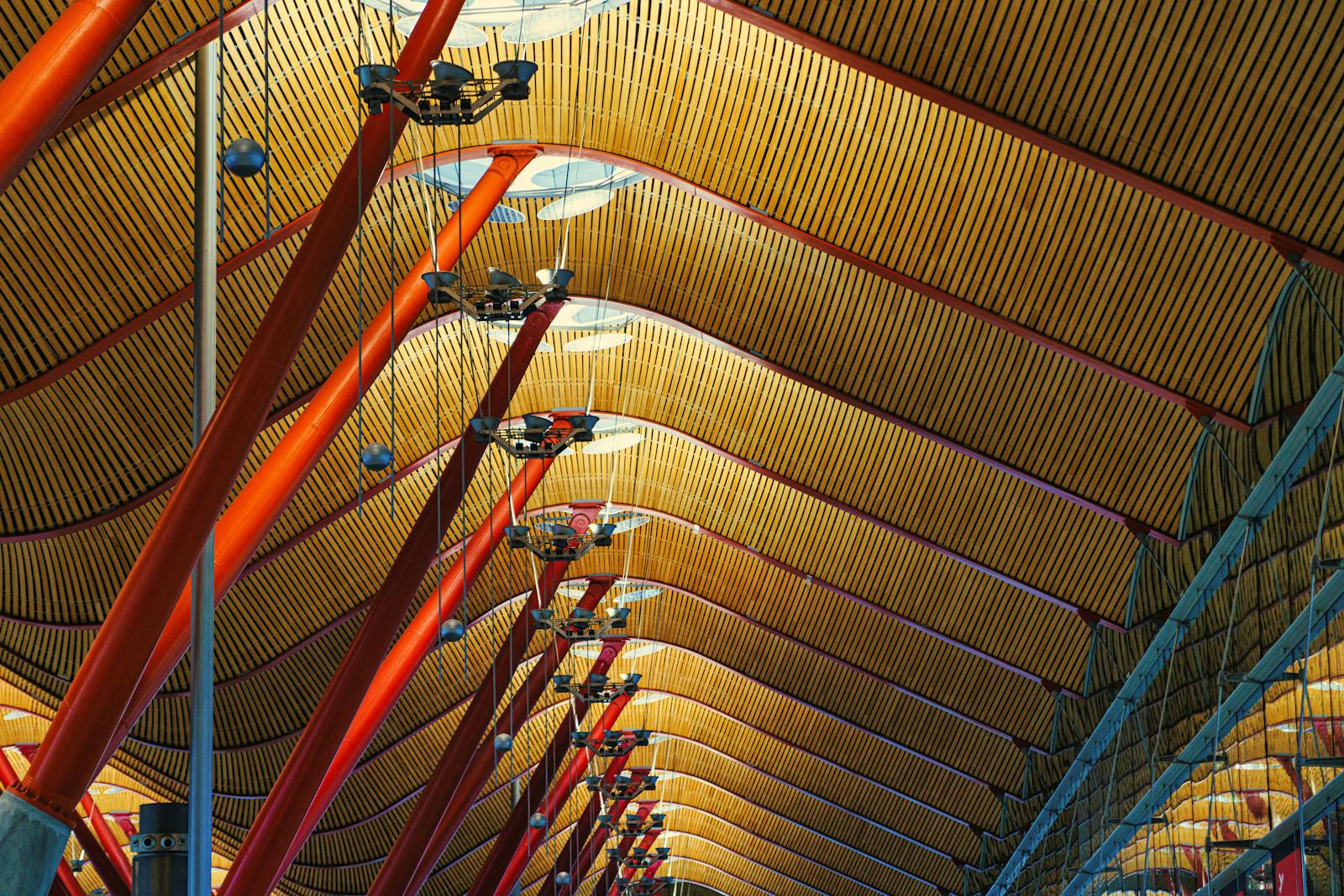
The roof is the thing everyone remembers: a vast, undulating wave of bamboo slats, broken by skylights that pour daylight down through the building’s floors. It is held up by steel “trees” painted in a gradient of colour that shifts along the length of the terminal, which is not just decoration; it helps you gauge how far along the building you are. Glass walls on the long sides let in more natural light and give views of the planes and, on a clear day, the Sierra de Guadarrama.
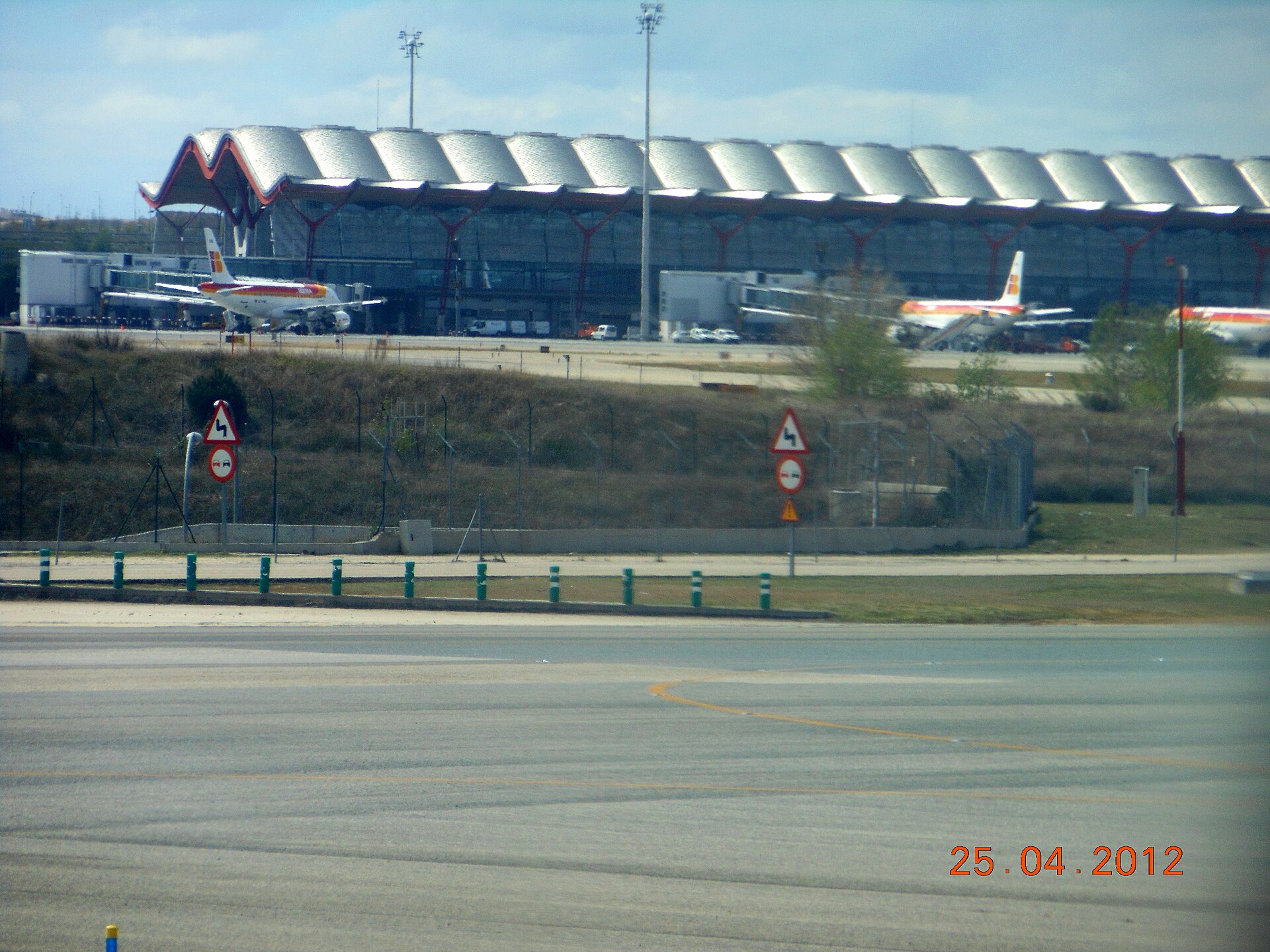
T4S, the satellite, is a near twin, standing on its own about two kilometres away across the aprons. Passengers never walk between the two; they ride the automated train (APM) through a tunnel beneath the taxiways.
How T4 and T4S Are Laid Out
Thinking of T4 in three layers — landside, airside in T4, airside in T4S — makes everything simpler.
Landside in T4
- Check-in and bag drop are on the departures level, in long numbered rows, with Iberia and British Airways self-service kiosks and bag-drop machines.
- Arrivals are on a lower level, with the meeting point, cafés, car hire, cash machines, a pharmacy and tourist information.
- The train stations — the Cercanías C1 and Metro Line 8 — are beneath the terminal, reached by lifts and escalators from arrivals.
- Aerotel, the transit hotel, is on level −1.
- The taxi rank, Exprés Aeropuerto bus and inter-terminal bus stops are outside the arrivals level.
Airside in T4
After central security, you are in the Schengen area of T4, with the H, J and K gates, shops, restaurants and the Iberia Velázquez lounge. Flights to other Schengen countries and within Spain leave from here — though Schengen flights can also use the M gates in T4S. Signs for T4S point you downstairs to the train.
Airside in T4S
T4S has two areas separated by passport control. The M gates are Schengen, reached directly from the train. The R, S and U gates are non-Schengen, for long-haul flights and destinations such as the UK, and you reach them through outbound passport control inside T4S. The Iberia Dalí lounge, the biggest duty-free shopping and the GettSleep pods are on the non-Schengen side.
Departing from Terminal 4: Step by Step
How early to arrive
| Your flight | Arrive at T4 at least | Why |
|---|---|---|
| Domestic or Schengen, hand luggage, checked in online | 1 hour 30 minutes before departure | Security, then a walk of up to 20+ minutes to H, J or K gates |
| Schengen with checked bag | 2 hours | Bag-drop queues vary widely |
| Non-Schengen from T4S (UK, Americas, etc.) | 2 hours 30 minutes | Security in T4, train, passport control in T4S, then the gate |
| Long-haul at peak times (morning banks, summer, holiday weekends) | 3 hours | Passport queues and bag drop can both be slow |
1. Check in and drop bags
Check your row on the screens as you enter. If you have a boarding pass and only need to drop a bag, the self-service bag-drop machines are usually quickest. Premium passengers and oneworld elite members have dedicated desks.
2. Security
Central security in T4 is large and usually fast, but mornings from about 06:00 to 10:00 and summer weekends can be busy. Fast Track is available to eligible passengers and can be bought. Follow the officers’ instructions about liquids and electronics; rules have changed more than once recently.
3. T4 gates or the train to T4S
If your gate begins with H, J or K, you stay in T4 — but check the walking time on the signs; the far end of K is a long way from security. If your gate begins with M, R, S or U, follow the signs for T4S down to the train. It runs every few minutes, and the ride takes about three minutes. Allow ten minutes from security to arriving in T4S.
4. Passport control in T4S (R, S and U gates)
For non-Schengen flights, passport control is after the train, as you enter T4S. EU passport holders can usually use e-gates. Everyone else joins the manual queue, which varies from five minutes to much longer when several long-haul flights depart together.
5. The gate
Gates are often announced only 40 to 60 minutes before departure. In T4S, the distances are shorter than in T4 — the signs give 6 to 11 minutes to R, S and U — so once you are through passport control, you can wait comfortably near the shops and head to the gate when it appears. Boarding typically closes 15 to 20 minutes before departure, earlier for some long-haul flights.
Tax-free refunds
If you are leaving the EU and have tax-free forms, validate them at a DIVA kiosk before security in T4, on the departures level. Once you are airside, you cannot go back. Our guide to tax-free shopping in Madrid has the details.
Arriving at Terminal 4: Step by Step
If you land at T4S from outside Schengen
- Walk to passport control in T4S. Follow signs for baggage reclaim and exit. Non-EU visitors now go through the EU’s Entry/Exit System, which captures fingerprints and a photo on first entry and adds time.
- Take the train to T4. Your bags are not in T4S; they are in the main terminal.
- Collect bags in T4, in the large reclaim hall.
- Clear customs — green channel if you have nothing to declare.
- Exit into the arrivals hall.
From stepping off the plane to the arrivals hall, allow 45 minutes on a quiet day and well over an hour when several long-haul flights arrive together in the early morning.
If you land at T4 or T4S from a Schengen or domestic flight
No passport control. If you arrive at M gates in T4S, take the train to T4. Collect bags and exit. Allow 20 to 40 minutes, depending on how far you walk and how quickly the bags come out.
From the arrivals hall into Madrid
T4 is the best-connected terminal at Barajas because it is the only one with a Cercanías station.
| Option | Where to find it | Time to centre | Cost |
|---|---|---|---|
| Cercanías C1 | Below T4, follow Renfe signs | 19 min to Chamartín; about 33 to Atocha | About €2.60 |
| Metro Line 8 | Below T4, follow Metro signs | About 22 min to Nuevos Ministerios, then change | About €4.50–€5 including the €3 airport supplement |
| Exprés Aeropuerto 203 | Outside arrivals | 35–45 min to Cibeles and Atocha | €5 |
| Taxi | Rank outside arrivals | 20–45 min depending on traffic | €33 flat fare inside the M-30 |
If you are catching a long-distance train onward from Atocha or Chamartín, check your Renfe ticket for a free Cercanías connection code before you pay for the C1. The full walkthrough of each option is in our guide to getting from Madrid airport to the city centre, and onward rail travel is covered in trains from Madrid.
Connecting Flights in Terminal 4
Most connections at T4 are between Iberia and oneworld flights and stay within the T4–T4S complex. How long they take depends on which side of the Schengen line you start and end on.
| Connection | What you do | Comfortable time |
|---|---|---|
| Schengen → Schengen (e.g. Paris → Madrid → Seville) | Stay airside; walk or take the train between T4 and T4S if needed | 1 hour |
| Non-Schengen → Schengen (e.g. New York → Madrid → Rome) | Passport control into Schengen, and often a security check, then to your gate | 1 hour 30 minutes+ |
| Schengen → non-Schengen (e.g. Barcelona → Madrid → Mexico City) | Train to T4S if needed, passport control out, then to your gate | 1 hour 15 minutes+ |
| Non-Schengen → non-Schengen (e.g. London → Madrid → Lima) | Stay in the transit area of T4S if both flights use it; follow transfer signs | 1 hour 15 minutes+ |
| T4 → T1 or T2 (different airline or alliance) | Exit, collect bags if not checked through, free bus, check in and security again | 2 hours (single ticket) to 3 hours (separate tickets) |
Iberia sells some connections with shorter minimum times than those above, and on a single ticket the airline has to rebook you if you miss a connection because of a delay. The times in the table are the ones we would actually plan around, especially if your inbound flight is long-haul and lands in the early-morning rush.
Follow the “Connecting flights” / Conexiones signs when you get off the plane rather than heading for the exit, and check the departure screens for your onward gate as soon as you can. If you have a checked bag on a single ticket, it should be checked through to your final destination; if your first point of entry into Schengen is Madrid, ask at your origin whether you need to collect it.
Food, Shops and Lounges
Eating
T4 and T4S both have a reasonable range of cafés, bars and sit-down restaurants airside, including Spanish options for tortilla, jamón, croquetas and a glass of wine, plus international chains. Some outlets in T4 and T4S run 24 hours. Prices are airport prices. If you are arriving and hungry, the landside cafés in T4 arrivals will do, but a proper meal in town is half an hour away.
Shopping
The biggest duty-free and luxury shopping is in the non-Schengen area of T4S, with a large walk-through duty-free store, Spanish fashion brands and gourmet shops selling jamón, olive oil and wine. T4’s Schengen area has a smaller selection. Buy food gifts in town if you can; the choice is better and the prices lower.
Lounges
- Iberia Velázquez lounge (T4): for Schengen departures. Open to Iberia and oneworld business-class passengers and eligible oneworld elite members.
- Iberia Dalí lounge (T4S): for non-Schengen and long-haul departures, with showers and a larger food offering. Same access rules.
- Aena VIP lounges: the airport operator’s own lounges accept paid entry and lounge-membership programmes such as Priority Pass. Check the Aena website for current locations, prices and opening times; booking online in advance is usually cheaper.
Sleeping, Showers and Waiting
- Aerotel Madrid is on level −1 of T4, landside. Private rooms bookable in blocks of 3, 6 or 12 hours, with showers. Ideal for a late arrival and an early train, or a long layover when you want to leave the airside area. You will clear security again afterwards.
- GettSleep sleeping pods are in T4S, airside, bookable for 3 to 24 hours, with showers, open 24/7. The best option for a long non-Schengen connection when you never want to leave the satellite.
- The Dalí lounge has showers for eligible passengers.
- Overnight in the terminal: T4 is open 24 hours and you can wait landside. It is safe and bright, but not quiet or comfortable. The upper levels are usually calmer.
For a full night’s sleep, a hotel near the airport with a shuttle is often cheaper and more restful. See hotels near Madrid airport.
Practical Services
- Wi-Fi: free and unlimited across T4 and T4S.
- Charging: power sockets in many seating areas, especially near the gates.
- Left luggage: Aena lists a left-luggage service in T4, on the landside. Check prices and hours before you rely on it for a layover.
- Money: cash machines in arrivals and airside. Use a bank ATM and decline dynamic currency conversion.
- Pharmacy: landside in T4, with others airside.
- Reduced mobility assistance: Aena’s free assistance service covers the long walks, the train to T4S and boarding. Request it through your airline at least 48 hours before you fly; on the day, use the help points at the terminal entrances.
- Car parks: short-stay parking next to T4 and long-stay options with shuttles. Book online for the best price.
- Smoking: not allowed inside, and there are no airside smoking areas.
T4 Through the Day
The same building feels completely different depending on when you pass through it.
- Early morning (about 05:30–10:00). The busiest stretch. Overnight long-haul flights from the Americas land at T4S while the first wave of European and domestic departures leaves T4. Arrivals passport control, bag drop and central security can all be slow at once. Build in extra time in both directions.
- Middle of the day. Usually the calmest period for departures, with shorter queues and quieter cafés. A good time to arrive for an afternoon flight and enjoy the building.
- Late afternoon and evening (about 16:00–20:00). A second peak, as the evening long-haul departures to Latin America and the United States gather in T4S. Passport control at T4S can back up.
- Late night. T4 stays open, but most shops close and food options shrink to the 24-hour outlets. The C1 and Metro stop around midnight to 01:30; after that, the Exprés Aeropuerto bus and taxis are your only ways into town.
Seasonally, summer weekends, the Easter week, the start and end of August and the Christmas holidays are the heaviest periods. If you are flying at one of those times from T4S, add half an hour to everything above.
How Not to Miss Your Flight from T4
After years of watching people run through this building, these are the traps that matter.
- Going to the wrong terminal. Iberia is at T4, but some codeshares and partner flights are operated by airlines in other terminals. Check your booking for the operating carrier and terminal.
- Ignoring T4S. A “T4” flight with an R, S or U gate involves security, the train and passport control. Treat it as a separate stage of your journey.
- Waiting in the wrong place for the gate announcement. If you are flying Schengen from T4, you may be sent to the far end of K or to the M gates in T4S. Stay central until the gate appears, then move at once.
- Arriving in the morning rush without a margin. Between about 06:00 and 10:00, bag drop, security and T4S passport control can all be slow on the same morning.
- Taking the Metro to the wrong stop. Line 8 stops at Aeropuerto T1-T2-T3 before Aeropuerto T4. Stay on until the end.
- Relying on a taxi at rush hour. The A-2 and M-40 jam from about 07:30 to 09:30. The C1 train from Chamartín or Atocha is more predictable.
Is T4 a Good Terminal?
It is one of the best airport buildings in Europe: bright, spacious, beautiful and generally efficient, with free unlimited Wi-Fi, a direct rail link to the city and good connections for Iberia and oneworld passengers. Its weaknesses are its size — the walks are genuinely long — and the extra stage that T4S adds to non-Schengen journeys. Once you understand that, it is an easy and even enjoyable terminal to use.
Frequently Asked Questions
Which airlines use Madrid Terminal 4?
Mainly Iberia, Iberia Express and Air Nostrum, and oneworld partners such as British Airways, American Airlines, Qatar Airways, Finnair and LATAM, plus several other long-haul carriers. Always confirm your terminal with your airline.
What is the difference between T4 and T4S?
T4 is the main terminal with check-in, security, arrivals, the train stations and the H, J and K gates. T4S is the satellite building, reached by underground train in about three minutes, with the M gates for Schengen flights and the R, S and U gates for non-Schengen flights.
How long does it take to get from T4 to T4S?
The train ride is about three minutes. From T4 security to arriving in T4S, allow about ten minutes, plus time for passport control if your flight is non-Schengen.
Where is passport control in Madrid T4?
For non-Schengen departures, passport control is in T4S, after the train and before the R, S and U gates. For non-Schengen arrivals, it is in T4S before you take the train to baggage reclaim in T4.
How do I get from T4 to T1 or T2?
Take the free inter-terminal bus from outside arrivals, which runs 24 hours. Allow 20 to 30 minutes door to door. You can also take Metro Line 8 one stop, but you will pay a fare.
Is there a train from Madrid T4 to the city centre?
Yes. The Cercanías C1 runs from T4 to Chamartín in about 19 minutes and Atocha in about 33, for around €2.60. Metro Line 8 also serves T4.
Can I sleep in Madrid T4?
Yes. Aerotel on level −1 of T4 (landside) and GettSleep pods in T4S (airside) offer private rest. You can also wait overnight in the public areas.
How early should I arrive at T4 for an international flight?
At least two and a half hours for a non-Schengen flight from T4S, and three hours at peak times or with checked bags.
Related Madrid Guides
- Madrid Airport: The Complete Guide
- Madrid Airport to City Centre
- Hotels Near Madrid Airport
- Madrid Cercanías Trains
- Madrid Metro Map and Guide
- Trains from Madrid
- Madrid Travel Tips
Photo Credits
Terminal 4 from the airfield: Madrid Barajas Airport-Terminal 4 (7000292700) by Charles from Port Chester, New York, CC BY 2.0, via Wikimedia Commons.
Gate signs in Terminal 4: Madrid-Barajas Airport – Terminal 4 – 1 by ProtoplasmaKid, CC BY-SA 3.0, via Wikimedia Commons.