Plaza Mayor Madrid history spans four centuries — designed by Juan Gómez de Mora, commissioned by King Felipe III in 1617, completed in 1620 on the site of the medieval Plaza del Arrabal market. The 129m × 94m rectangular Habsburg square has hosted bullfights (since 1619), royal coronations, public executions during Inquisition autos-da-fé (most notoriously the June 30, 1680 trial of 117 condemned), proclamations, soccer games, Christmas markets, and modern political demonstrations. Three major fires (1631, 1670, 1790) led to gradual rebuilding — the current four-story uniform façade dates from Juan de Villanueva’s 1791 reconstruction. This guide covers Plaza Mayor Madrid history era by era plus what to see today during your visit.
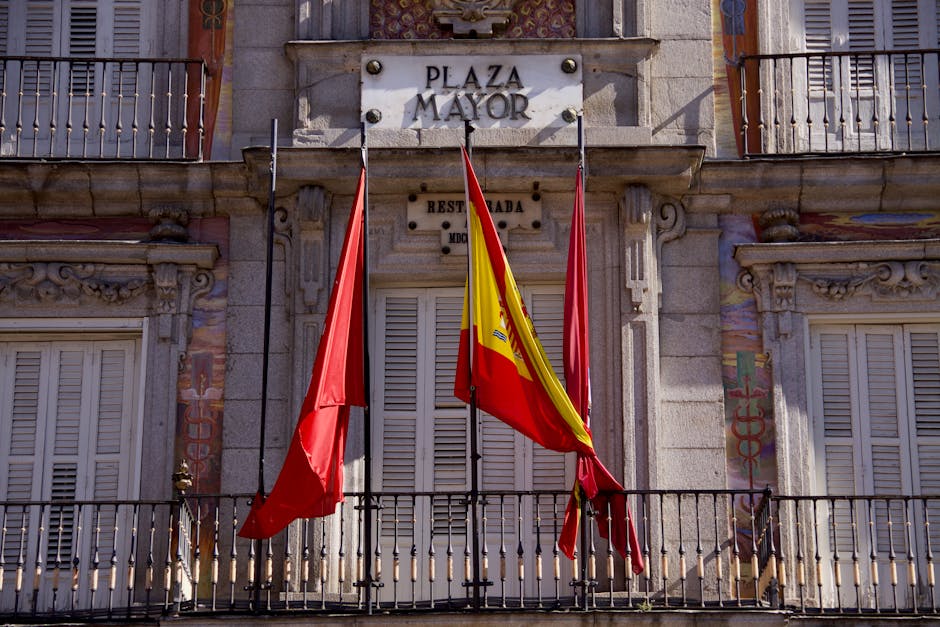
Table of Contents
- Plaza Mayor Madrid History: Medieval Origins
- Construction 1617-1620
- Plaza Mayor Madrid History Events
- Plaza Mayor Madrid Architecture
- Plaza Mayor Today: What to See
- Restaurants and Cafés Around Plaza Mayor
- Plaza Mayor Modern Events
- Plaza Mayor Madrid History: Visitor Tips
- FAQs
Plaza Mayor Madrid History: Medieval Origins
Before becoming Plaza Mayor, the site was Plaza del Arrabal — a chaotic medieval market square outside Madrid’s 11th-century Moorish city walls. The “arrabal” (suburb) developed organically through the 13th-15th centuries as a commerce hub for the small Castilian town. By the 16th century, irregular wood-frame buildings surrounded a triangular open space used for daily markets.
When Felipe II made Madrid Spain’s capital in 1561, the new royal court found Plaza del Arrabal embarrassingly chaotic. Plans for a regularized rectangular plaza began under Felipe II but stalled. His successor Felipe III commissioned the redesign in 1617 — entrusted to court architect Juan Gómez de Mora, a disciple of Juan de Herrera (architect of El Escorial).

Construction 1617-1620
- Architect: Juan Gómez de Mora, Madrid’s premier Habsburg architect.
- Inspiration: Italian Renaissance plaza ideals adapted to Castilian Baroque.
- Dimensions: 129m × 94m rectangle.
- Capacity: Up to 50,000 spectators for major events.
- Original façade: Five-story buildings with continuous arcades on ground level.
- Casa de la Panadería (Bakery House): Northern side; Habsburg administrative building with frescoed façade.
- Casa de la Carnicería (Butcher House): Southern side mirror.
- Inaugurated: 1620 with festivities.
- Equestrian statue of Felipe III: 1616 by Pietro Tacca and Giovanni Bologna; centerpiece since 1848 (originally elsewhere).
Plaza Mayor Madrid History Events
- 1619 (before completion): First bullfight; two daily fights — morning for commoners, afternoon for King and nobles at double price.
- 1620: Inaugural festivities.
- 1631: First major fire destroys eastern section.
- 1670: Second major fire.
- 1680 (June 30): Most notorious auto-da-fé — Spanish Inquisition trial of 117 people; 21 condemned to death by burning.
- 1701: Coronation of Felipe V (first Bourbon king).
- 1789: Coronation of Carlos IV.
- 1790: Third major fire destroys most of the plaza.
- 1791-1797: Juan de Villanueva’s reconstruction; reduced to current 4 stories; uniform Neoclassical façade.
- 1808 (May 2): Site of Madrid uprising against Napoleonic French.
- 1846: Equestrian statue of Felipe III moved to current center position.
- 1991: Plaza Mayor pedestrianized.

Plaza Mayor Madrid Architecture
- 237 wrought-iron balconies: Decorate the four-story uniform façade.
- 114 ground-floor arcades: Restaurants, shops, cafés.
- 9 entrance archways: Including Arco de Cuchilleros (knife-makers’ arch); Arco de la Sal (salt arch).
- Casa de la Panadería: Frescoed façade by Carlos Franco (1992) replacing earlier deteriorated murals; nymphs and mythological figures.
- Equestrian statue of Felipe III: Bronze 1616; the only equestrian statue inside the plaza.
- Slate roofs and Habsburg dormers: Steep pitched roofs unusual for Madrid; reflects Felipe II’s Flemish architectural preferences.
Plaza Mayor Today: What to See
- Felipe III equestrian statue: Center of plaza; iconic photo.
- Casa de la Panadería: Carlos Franco’s 1992 mythological frescoes.
- Arco de Cuchilleros: Most famous entrance; opens to Calle Cuchilleros.
- Sobrino de Botín restaurant: World’s oldest continuously operating restaurant (1725); just outside Plaza Mayor through Cuchilleros arch.
- Mercado de San Miguel: Iconic 1916 gourmet food market; 2-min walk.
- Christmas market (December 1-31): 100+ stalls; magical atmosphere.
- Sunday morning calm: Best photography light; pre-Rastro market.
- Stamp and coin market Sunday mornings: Traditional collectors’ gathering.

Restaurants and Cafés Around Plaza Mayor
- Sobrino de Botín (Calle Cuchilleros 17): World’s oldest continuously operating restaurant since 1725; cochinillo asado (suckling pig) is the iconic dish; €50-70 per person; reservations required.
- Mercado de San Miguel: Multiple gourmet stalls.
- Plaza Mayor arcade restaurants: Tourist-trap pricing; better to walk 2-3 blocks.
- Cervecería Plaza Mayor: Casual.
- Mesón Cuevas del Vino (Calle Cuchilleros): 17th-century wine cellar setting.
Important: avoid restaurants directly on Plaza Mayor — pricing is 40-60% above 2-block-away alternatives. Walk to Calle Cuchilleros, Calle Cava Baja, or Mercado de San Miguel for better quality at fair prices.
Plaza Mayor Modern Events
- Christmas market (Dec 1-31): 100+ stalls of nativity scenes, ornaments, traditional crafts. Most magical Madrid Christmas spot.
- San Isidro festival (May 15): Patron saint celebration; concerts in plaza.
- San Fermín (July 6-14): Solidarity celebrations with Pamplona.
- National holidays: Various civic events.
- Sunday morning stamp/coin market: Tradition since 1927.
- Free walking tours: Most start in Plaza Mayor.

Plaza Mayor Madrid History: Visitor Tips
- Best photography time: Sunday morning (calm); blue hour (30 min after sunset).
- Avoid restaurant arcades: Tourist-trap pricing; better quality 2 blocks away.
- Watch for pickpockets: High tourist concentration.
- Free entry always: No ticket needed.
- Combine with Mercado de San Miguel: 2-min walk.
- Combine with Royal Palace: 8-min walk.
- Christmas market essential December: Magical atmosphere.
- Skip the human statues: Tourist-trap aggressive solicitation.
- Interpretive panels: Multilingual; explain history.
FAQs
When was Plaza Mayor built?
Designed by Juan Gómez de Mora; commissioned 1617 by Felipe III; completed 1620. Reconstructed by Juan de Villanueva 1791-1797 after the third major fire.
Who designed Plaza Mayor Madrid?
Juan Gómez de Mora (1620 original); Juan de Villanueva (1791 reconstruction). Both court architects of the Spanish royal house.
What’s the equestrian statue at Plaza Mayor?
King Felipe III (1578-1621). Bronze statue cast 1616 by Pietro Tacca and Giovanni Bologna. Moved to plaza center 1846.
Did the Spanish Inquisition use Plaza Mayor?
Yes — most notoriously the June 30, 1680 auto-da-fé where 117 people were sentenced and 21 condemned to death by burning.
Is Plaza Mayor pedestrian-only?
Yes since 1991. Cars not permitted within the plaza.
What’s the world’s oldest restaurant near Plaza Mayor?
Sobrino de Botín on Calle Cuchilleros 17 — Guinness-certified world’s oldest continuously operating restaurant since 1725.