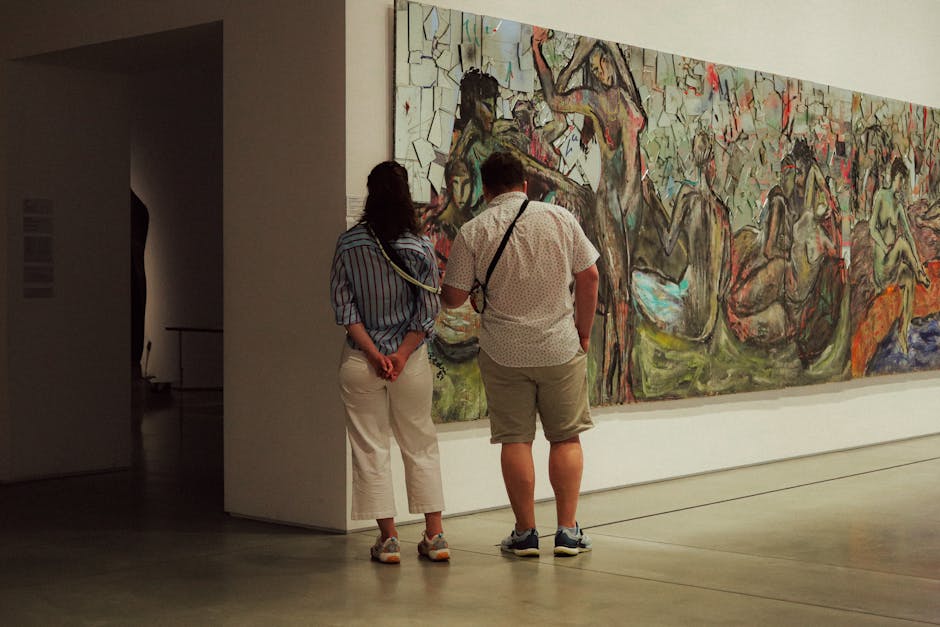
Guernica is the reason most people go to the Reina Sofía — Picasso’s 11-foot canvas fills Room 205.10 on the second floor, and it’s the only place in the world you’ll ever see it. But the Reina Sofía is more than one painting: it holds Spain’s national collection of 20th- and 21st-century art, including major Dalí and Miró rooms that often get overlooked in the rush toward the Picasso. The museum occupies a converted 18th-century hospital plus a striking 21st-century extension by Jean Nouvel, and it’s the third corner of Madrid’s art triangle alongside the Prado and the Thyssen. Tickets are €12 (2026), with free entry several hours each day. This is the one museum I’d tell visitors to pair with the Prado on a full day of things to do in Madrid.
Table of Contents
- At a Glance
- Guernica — Everything You Need to Know
- Beyond Guernica: What Else to See
- The Building
- How to Plan Your Visit
- Tickets and Free Hours
- FAQs
Reina Sofía: At a Glance
- Address: Calle de Santa Isabel 52, 28012 Madrid (entrance also from Ronda de Atocha)
- Opening hours: Monday, Wednesday–Saturday 10am–9pm; Sunday 10am–2:30pm; closed Tuesdays
- Closed: Tuesdays, January 1, January 6, May 1, December 25
- Standard ticket: €12 (2026); reduced €6 for students and seniors
- Free entry: Monday, Wednesday–Friday 7pm–9pm; Saturday 2:30pm–9pm; Sunday 12:30pm–2:30pm; permanent free for under-18s
- Metro: Atocha (Line 1) or Estación del Arte (Line 1) — 3-minute walk
- Average visit: 2–3 hours for the full permanent collection; 1.5 hours if focused on Guernica + highlights
Guernica: Everything You Need to Know
Picasso painted Guernica in 1937 in response to the Nazi bombing of the Basque town of Guernica during the Spanish Civil War — commissioned for the Spanish Pavilion at the Paris International Exposition. The 3.49m × 7.76m canvas in grey, black, and white depicts the aftermath: a screaming horse, a bull, dismembered bodies, a mother cradling a dead child, a lamp held aloft. It became the defining image of 20th-century anti-war art almost immediately.
Picasso refused to allow the painting to return to Spain while Franco was alive. It was held at MoMA in New York from 1939 until Franco’s death; it arrived in Madrid in 1981. This history — the painting’s own exile and return — is part of what makes seeing it in person so charged. It belongs here in a way few artworks belong in their current homes.
Practical notes for Room 205.10: The room is large but the painting still dominates it completely. Photography is not permitted. Guards enforce this strictly — and it’s worth putting the phone away to actually look. Allow at least 20 minutes. The surrounding rooms contain Picasso’s preparatory studies for Guernica (photographs, sketches, working notes), which dramatically enrich your reading of the final canvas.
Beyond Guernica: What Else to See
Most visitors spend all their time on the Picasso floor and miss some extraordinary work elsewhere. Here’s where I’d point you:
Salvador Dalí (Collection 1)
The Reina Sofía holds a significant Dalí collection, including “The Great Masturbator” (1929) and “The Enigma of Hitler” (1939). These are in Collection 1 (the original hospital building), and they tend to be far less crowded than the Guernica rooms. If you’re a Dalí fan, this alone is worth the €12.
Joan Miró
The Reina Sofía holds early Miró works that predate his mature abstract style — paintings from the 1920s that still show his Catalan landscape roots before the biomorphic symbols took over. Often overlooked.
Juan Gris
One of the strongest Cubist collections outside Paris, anchored by Juan Gris’s precise, cerebral canvases from the 1910s–1920s. Worth comparing directly with the Picasso rooms to see how differently the two artists worked within the same movement.
Contemporary Floors (Nouvel Building)
The red Jean Nouvel extension (Collection 3 and 4) hosts post-1968 international contemporary art — more demanding, less immediately accessible than the historic modernism floors, but the architecture alone is worth a wander. Don’t miss the rooftop terrace view over the Atocha station.
The Building
The original structure is the Hospital General de Madrid, an 18th-century building that was converted into a contemporary art museum in the 1980s. The glass external elevators on the facade — added by Ian Ritchie in 1990 — look incongruous at street level but make good practical sense inside (the building has multiple floors and poor internal circulation). In 2005, Jean Nouvel added the red triangular steel extension that now houses Collections 3 and 4; it’s one of the more interesting pieces of museum architecture in Spain, particularly the open atrium under the canopy roof.
How to Plan Your Visit
1.5 Hours (Guernica Focus)
Enter via Calle Santa Isabel. Head directly to Collection 2 (second floor of the original building) — Guernica is in Room 205.10. Allow 20 minutes for Guernica and the surrounding preparatory studies, then cover the Dalí and Miró rooms nearby before exiting. Skip the Nouvel extension on this visit.
3 Hours (Full Permanent Collection)
Start with Collection 1 (the oldest works — Picasso’s early canvases, Gris, the pre-war avant-garde) on the 4th floor. Move to Collection 2 (Guernica + Dalí + Miró) on the 2nd floor. Take the glass elevators to the Nouvel building for Collections 3 and 4. The museum café in the Nouvel building is a decent rest stop at the midpoint.
If you’re planning to visit the Prado and Thyssen on the same trip, the Golden Triangle guide has a suggested two-day itinerary that covers all three without burning out. The Madrid museums guide is the place to compare which museums are right for your interests — the Reina Sofía is essential for anyone interested in modern art; visitors focused purely on Old Masters can be more selective.
Tickets and Free Hours
Standard ticket: €12 (2026). Reduced: €6 for students, seniors, groups. Under-18 always free.
Free hours: Monday, Wednesday–Friday 7pm–9pm; Saturday 2:30pm–9pm; Sunday 12:30pm–2:30pm. These are genuinely free — no booking required, just queue at the door. The evening free slots (7pm–9pm weekdays) tend to be less crowded than the Saturday afternoon ones. If you’re managing costs across multiple museums, cross-check with the full free things to do in Madrid guide for the best combination.
The Paseo del Arte combined ticket (€32, 2026) covers one visit each to the Reina Sofía, the Prado, and the Thyssen-Bornemisza — valid for a year. Worth it if you’re doing all three.
👉 Full guide: Madrid museums guide — which ones to prioritize
Reina Sofía Museum FAQs
Can you see Guernica at the Reina Sofía?
Yes — it’s in Room 205.10 on the second floor of the original building and is the museum’s centerpiece. It’s the only place in the world where you can see the original canvas. Photography is not permitted in the room.
Is the Reina Sofía free?
Partial free entry: Monday, Wednesday–Friday 7pm–9pm; Saturday 2:30pm–9pm; Sunday 12:30pm–2:30pm. Under-18s always free. Standard ticket €12 (2026).
How long does a visit take?
1.5 hours for Guernica and the main highlights. 2.5–3 hours for the full permanent collection including the Nouvel extension.
What’s the difference between the Reina Sofía and the Prado?
The Prado covers 12th–19th-century European painting: Velázquez, Goya, Bosch, Titian. The Reina Sofía covers 20th- and 21st-century art: Picasso, Dalí, Miró, and contemporary international artists. They’re complementary, not competing.
Is the Reina Sofía good for children?
Reasonably so — under-18s are free, and Guernica, Dalí, and Miró tend to engage children more than Old Master painting. The museum also runs family workshops on certain weekends. For a broader view of family-friendly options in Madrid, the Madrid with kids guide has specific suggestions.
Where is the Reina Sofía?
Calle de Santa Isabel 52, directly opposite Atocha station. Metro: Atocha (Line 1) or Estación del Arte (Line 1), 3-minute walk.
Plan Your Visit
- Things to do in Madrid — the full guide
- Golden Triangle: Prado, Reina Sofía & Thyssen explained
- Which Madrid museums to prioritize
- Prado Museum — tickets and visitor guide
- Thyssen-Bornemisza Museum visitor guide
- Madrid itinerary planner
- Madrid Museum Pass
- Free Museum Hours Madrid
- Contemporary Art Galleries in Madrid
- Top Things to See in Madrid
The Reina Sofía earns its €12 on Guernica alone. But the Dalí rooms are a genuine surprise for most visitors — less theatrical than the Figueres museum, more concentrated and serious. Give yourself at least 2 hours.