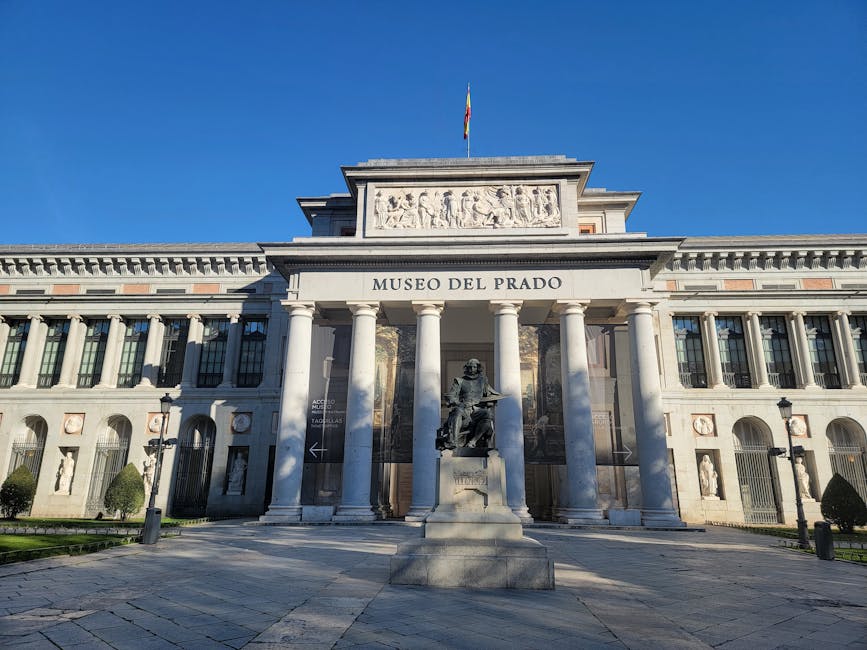
The Prado holds one of the greatest concentrations of European painting anywhere on earth — around 1,500 works on permanent display from a collection of 8,000+ paintings built by Spanish royalty across five centuries. If you only go to one museum in Madrid, this is it. This guide covers tickets (€15, or free during evening hours), the unmissable masterpieces by room number, suggested itineraries by time budget, and practical tips that will save you a queuing headache. For a fuller picture of things to do in Madrid, the Prado fits naturally into a morning before an afternoon in nearby Retiro Park.
Table of Contents
- Prado Museum Madrid at a Glance
- Top 12 Masterpieces You Must See
- Suggested Itineraries
- How to Buy Tickets
- Practical Tips
- Prado Museum FAQs
Prado Museum: At a Glance
- Address: Calle de Ruiz de Alarcón 23, 28014 Madrid
- Opening hours: Monday–Saturday 10am–8pm; Sunday and holidays 10am–7pm; January 6, December 24, and 31 close at 2pm
- Closed: January 1, May 1, December 25
- Standard ticket: €15 (online or at the door — no booking surcharge)
- Free entry: Monday–Saturday 6pm–8pm; Sunday and holidays 5pm–7pm; permanent free for under-18s, students under 25 with EU ID, and on certain dates (May 18 International Museum Day, October 12, November 9, December 6)
- Audio guide: €5 — worth it for first-time visitors
- Average visit: 2.5–4 hours; obsessives can spend 6+
- Metro: Banco de España (Line 2), Atocha (Line 1), or Estación del Arte (Line 1)
A Brief History
Juan de Villanueva designed the Prado building in 1785 for Carlos III — originally as a natural history cabinet, part of the Bourbon Enlightenment project that reshaped the Paseo del Prado into a science-and-arts axis alongside the Botanical Garden and the Royal Observatory. The Peninsular War derailed the science plan; Fernando VII’s wife María Isabel de Braganza pushed to repurpose it for the royal art collection. The Real Museo de Pintura y Escultura opened on November 19, 1819, with 311 paintings on display. Today the collection runs to roughly 27,000 works — about 1,500 on view at any time.
12 Paintings You Should Not Miss
This is where I’d steer any first-timer. These are in rough order of priority:
1. Las Meninas — Diego Velázquez (1656)
The single most debated painting in Western art. Velázquez paints himself painting the king and queen, who appear only in a small mirror at the back — making the viewer the implied subject. Room 12, first floor. Budget 10 minutes minimum and try to visit early before the crowds close in.
2. The Garden of Earthly Delights — Hieronymus Bosch (c. 1500)
The astonishing Flemish triptych of paradise, sin, and damnation — every inch packed with symbolism that still defies full explanation 500 years later. The Spanish kings collected Bosch voraciously; the Prado holds the deepest Bosch holdings in the world. Room 56A. Don’t rush it.
3. The Third of May 1808 — Francisco de Goya (1814)
Goya’s painting of Spanish patriots being executed by Napoleonic firing squads — often called the first modern painting for its raw emotional charge and rejection of heroic conventions. Hangs in Room 64 alongside its companion “The Second of May 1808.” One of the most affecting works in any museum.
4. The Black Paintings — Goya (1819–1823)
Goya’s late, despairing murals — Saturn Devouring His Son, Witches’ Sabbath, The Dog — were originally painted directly onto the walls of his country house and transferred to canvas after his death. Rooms 66–67. Some of the most psychologically intense painting ever made.
5. The Naked Maja and The Clothed Maja — Goya (c. 1797–1800)
The first non-allegorical nude in Spanish art — a real woman staring straight at you. Goya was investigated by the Inquisition for it. The clothed version was likely made to slide over the nude when visitors came. Room 36.

6. The Surrender of Breda — Velázquez (1635)
The Spanish general Spínola receives the keys to the surrendered Dutch city in a gesture of magnanimity rather than triumph. A masterclass in dignified diplomacy. Room 9A.
7. The Knight with His Hand on His Chest — El Greco (1580)
El Greco’s most iconic Spanish portrait, painted in his distinctive elongated style with that charged, hovering light he never fully explained. Room 9B.
8. The Three Graces — Peter Paul Rubens (1636)
One of Rubens’s most opulent late works. The Prado holds Spain’s enormous Habsburg collection of Rubens — far more than most visitors expect. Room 29.
9. Charles V at Mühlberg — Titian (1548)
The Holy Roman Emperor on horseback in full armor — the defining image of Renaissance kingship that influenced equestrian portraits for the next two centuries. Room 27.
10. Adam and Eve — Albrecht Dürer (1507)
The Northern Renaissance master’s only large-scale paintings of nudes — and a rare Dürer presence in any Spanish collection. Room 55B.
11. The Descent from the Cross — Rogier van der Weyden (c. 1435)
One of the supreme works of Northern Renaissance painting, with a psychological intensity that still stops people cold. Room 58.
12. The Annunciation — Fra Angelico (c. 1426)
Serene, gold-ground Italian early Renaissance — a quiet room after the drama of Goya. Room 56B.
How to Plan Your Time
90 Minutes
Focus only on the Spanish masters: Velázquez (Rooms 9–14, especially Las Meninas in Room 12) → Goya (Rooms 64–67, especially the Third of May and the Black Paintings) → El Greco (Room 9B). This is the most important Spanish art in the world. Everything else can wait for a return visit.
3 Hours (recommended first visit)
Add the Italian Renaissance (Rooms 49, 27, 56B) and Flemish/Northern masters (Room 56A for Bosch, Room 58 for van der Weyden, Room 55B for Dürer). Take a 20-minute coffee break in the basement café to reset your eyes around the 90-minute mark.
Full Day
Add Rubens and Flemish baroque (Rooms 16B, 29), Spanish 19th century (Rooms 60–61), the temporary exhibitions in the Jerónimos extension, and the sculpture and decorative arts on the lower floor. Take a proper lunch break — the museum café is functional but the surrounding Barrio de las Letras has far better options in every direction.
Tickets: What to Know
Online (Official Website)
Book at museodelprado.es — official, no surcharge, printable QR. In peak season (late spring through summer, plus weekends year-round), door queues can run 30–60 minutes. Online is the smarter move.
At the Door
Same price as online: €15 (2026). The Goya entrance (north side) usually has shorter queues than the Velázquez entrance (west side). Avoid Sunday afternoons and the free-hours rush.
Free Hours
Free entry runs 6pm–8pm Monday–Saturday and 5pm–7pm Sunday/holidays. There’s a genuine trade-off: the queue forms 45–60 minutes before doors open, the museum fills up, and you only have 2 hours inside. If €15 isn’t a stretch, the paid daytime slot is a noticeably better experience. If you’re on a tight budget, check the free things to do in Madrid guide — there’s a full breakdown of exactly when and how to get the free entry without the worst of the crowds.
Paseo del Arte Combined Pass
For €32 (2026), this covers one visit each to the Prado, the Reina Sofía, and the Thyssen-Bornemisza — valid for a year. Saves €13 over buying separately, and if you’re planning the full Golden Triangle of Madrid museums, it’s the obvious choice.
Practical Tips
- Bag check is mandatory for bags larger than 30x30cm. Free cloakroom at the entrance — drop your backpack and you’ll move much more easily through the galleries.
- Photography is prohibited inside the galleries. Pencil sketching is permitted (bring your own pencils).
- Free Prado app: Download before you visit — it has audio commentary and room-by-room maps, a genuine alternative to the paid audio guide.
- Best entrance: The Jerónimos entrance (north side, modern extension) consistently has the shortest queues.
- Best time: Tuesday or Wednesday morning at 10am, or late Friday afternoon around 4pm. Avoid Saturday afternoons and the last weekend of any month.
- Eat nearby: La Castela (Calle del Doctor Castelo, 22) for excellent croquetas; El Brillante near Atocha for a quick bocadillo de calamares (about €3.50 in 2026). Both are better than the museum café.
- Wear comfortable shoes: Hard floors, lots of walking. Layers help — gallery temperatures vary.
Guided Tours
Several options exist for going deeper:
- Official Prado tours: 1-hour highlights tour (€10 add-on to ticket); themed tours throughout the year.
- Context Travel: Small-group (max 6) art-historian-led tours for around €70–90 per person — the gold standard for serious art lovers.
- Private guides: €150–250 for a 2-hour private tour via licensed guides on madridguias.es.
Where to Eat Near the Prado
The Prado sits in the Barrio de las Letras (Literary Quarter), one of Madrid’s best-eating neighborhoods:
- La Castela (Calle del Doctor Castelo, 22): Classic neighborhood tavern, excellent croquetas, 5-minute walk.
- El Brillante (Plaza del Emperador Carlos V): Bocadillo de calamares, €3.50 (2026), 8-minute walk.
- Casa Lucio (Cava Baja, 35): The famous huevos estrellados — 15-minute walk, book ahead.
- Botin (Calle Cuchilleros, 17): World’s oldest restaurant per Guinness — 15-minute walk, always needs a reservation.
👉 Full guide: Madrid food guide — where and what to eat

Prado Museum FAQs
Is the Prado worth visiting?
Yes — unequivocally. It’s among the world’s top five art museums by collection quality. Even visitors who don’t normally enjoy museums find Las Meninas, the Bosch triptych, and Goya’s Black Paintings extraordinary. Plan a minimum 90-minute visit.
Can I take photos inside?
No. Photography is strictly prohibited in the galleries. Photos are fine in the lobby and outside the building.
How much time do I need?
90 minutes for a focused highlights tour. 3–4 hours for a thorough first visit. 6+ hours for a comprehensive deep dive, possibly split across two days.
Is entry free on Sundays?
Free entry runs Sunday 5pm–7pm and Monday–Saturday 6pm–8pm. Otherwise the standard ticket is €15 (2026).
Is it wheelchair accessible?
Yes. The museum has elevators serving all floors, accessible restrooms, and wheelchairs available free at the cloakroom (first-come basis).
What’s the difference between the Prado and the Reina Sofía?
The Prado covers art from roughly the 12th through the 19th century — medieval, Renaissance, baroque, and Goya. The Reina Sofía covers 20th-century Spanish art: Picasso’s Guernica, Dalí, Miró. They’re complementary; see both if you have the time.
When is the Prado least crowded?
Tuesday and Wednesday mornings at 10am opening are the quietest. Avoid Sunday afternoons (free-entry rush), Saturdays generally, and the summer midday peak.
Official Resources
- Official ticketing and exhibitions: Museo Nacional del Prado
- UNESCO World Heritage listing: Paseo del Prado and Buen Retiro
Plan Your Madrid Visit
The Prado pairs well with a full-day art itinerary along the Paseo del Arte. Combine it with the Reina Sofía and Thyssen and you’ve covered the entire sweep of Western painting in a single day — though most people find one museum is plenty for one day. If you’re combining with a walk, Retiro Park is a 10-minute walk from the Prado’s south entrance.
- Things to do in Madrid — the full guide
- Madrid museums guide
- Golden Triangle: Prado, Reina Sofía & Thyssen
- Madrid itinerary planner
- Barrio de las Letras guide
The Prado is dense, magnificent, and entirely doable in a focused half-day. Plan ahead, prioritize the masterpieces, and let the rest unfold at whatever pace your eyes can absorb.
Plan Your Visit
The Prado is closer to the airport than most visitors realise: the C1 train from Terminal 4 reaches Atocha in about half an hour, and the museum is a ten-minute walk from there. If you are passing through Madrid on a long layover, our layover guide shows how to fit in an hour with Velázquez and Goya and still make your flight.
1 response
Comments are closed.